Genealogical research in Tuscany often follows a familiar pattern: birth, marriage, and death records that tell a straightforward story. But every so often, you stumble across a set of documents that completely changes what you thought you knew; not just about a family tree, but about how a community protected its own.
Recently, while using FamilySearch’s AI-powered full-text search, I hit a surprising result that brought my great-great-grandfather Ghilardo Illidi, into an unexpected family secret, and a rare look at legal machinery in 1930s Bagni di Lucca.
The Discovery: A Cold Lead and an Indexed Name
Without full-text search, this three-page court record (verbale) from the Regia Pretura di Borgo a Mozzano dated June 5, 1930, would have remained hidden forever. Traditional indexing captures the main subjects of a file and, in this case, a 19-year-old groom named Giulio Sostenuti. His upcoming marriage to Polimia Bartoli, and the subsequent marriage supplements, weren’t on my radar.


Yet, there was my ancestor, Ghilardo Illidi, named right in the body of the document. Standing alongside him were members of the Lucchesi family from San Cassiano di Controne: Candido Lucchesi, Guido Lucchesi, and Serafino Lucchesi. The close relationship between Ghilardo and the Lucchesi family of Cembroni, I have written about before here.
Why was Ghilardo, a man of modest means who was himself a foundling (figlio di ignoti), standing in a magistrate’s court to sign legal papers for a young man I had never heard of?



The Legal Framework: Why Orphans Needed a Court Decree to Marry
To understand the document, I had to look at Italian civil law under the 1865 Civil Code (in force until 1942), with some good help from AI. In 1930, the age of legal majority was 21. Anyone younger needed parental consent to marry.
Giulio Sostenuti was 19 years old. He worked in San Cassiano and Montefegatesi, lived with an acquaintance, and wanted to marry Polimia Bartoli, a 19-year-old girl from Montefegatesi. But Giulio had no legal parents to give consent.
He was registered at birth as a figlio di ignoti. His surname, Sostenuti (meaning “supported” or “sustained”), was a classic surname typically assigned by civil authorities to foundlings raised on public charity. Because Giulio had no recognized family, the Magistrate (Pretore) had to formally convene a Consiglio di Tutela (Guardianship Council) to grant permission for the marriage. By law, the council required two separate legal guardians:
A Tutore (Primary Guardian): To grant official consent.
A Protutore (Surrogate/Backup Guardian): To ensure no conflict of interest existed.
Candido Lucchesi was appointed as the tutore. To act as the protutore, the court appointed Ghilardo Illidi.
“Il tutore informa che il giovane Sostenuti Giulio é persona da bene dimostra di essere affezionata verso la ragazza e da affidamento di potere mantenere decorosamente la famiglia che ha in animo di formarsi dato che é giovane lavoratore é pieno di buona volontà”
“The guardian informs that the young man Sostenuti Giulio is a respectable person, shows affection toward the girl, and gives every confidence that he can decorously support the family he intends to form, given that he is a working young man full of good will.”
– a statement by Argilide Carli, the guardian of Polomia Bartoli.
Lived Experience and the Lucchesi Circle
Seeing Ghilardo step into the courtroom as protutore carries deep personal significance. Having spent his own life navigating society as a foundling, Ghilardo knew the exact legal and social hurdles Giulio faced.
Because Giulio was “entirely without assets” (affatto privo di beni), the court waived the usual requirement for guardians to post a financial bond. Ghilardo’s role required no money; only his presence, his name, and his signature. There is a striking symmetry in a man who grew up without a legal family standing up in court to ensure another young foundling could legally start a family of his own.
Furthermore, seeing Ghilardo act in direct partnership with Candido and Guido Lucchesi provided concrete archival proof of their close bond and mutual trust in San Cassiano.
The Dramatic Turn: A Secret Revealed in the Marriage Banns
As complex as Giulio’s guardianship file was, the storyline took an even more dramatic turn when examining the accompanying marriage attachments (allegati).
Polimia, the bride, had her own court decree because her parents were deceased—her council, led by guardian Argilide Carli, noted movingly that Giulio was “a respectable person, shows affection toward the girl, and gives every confidence that he can decorously support the family.”
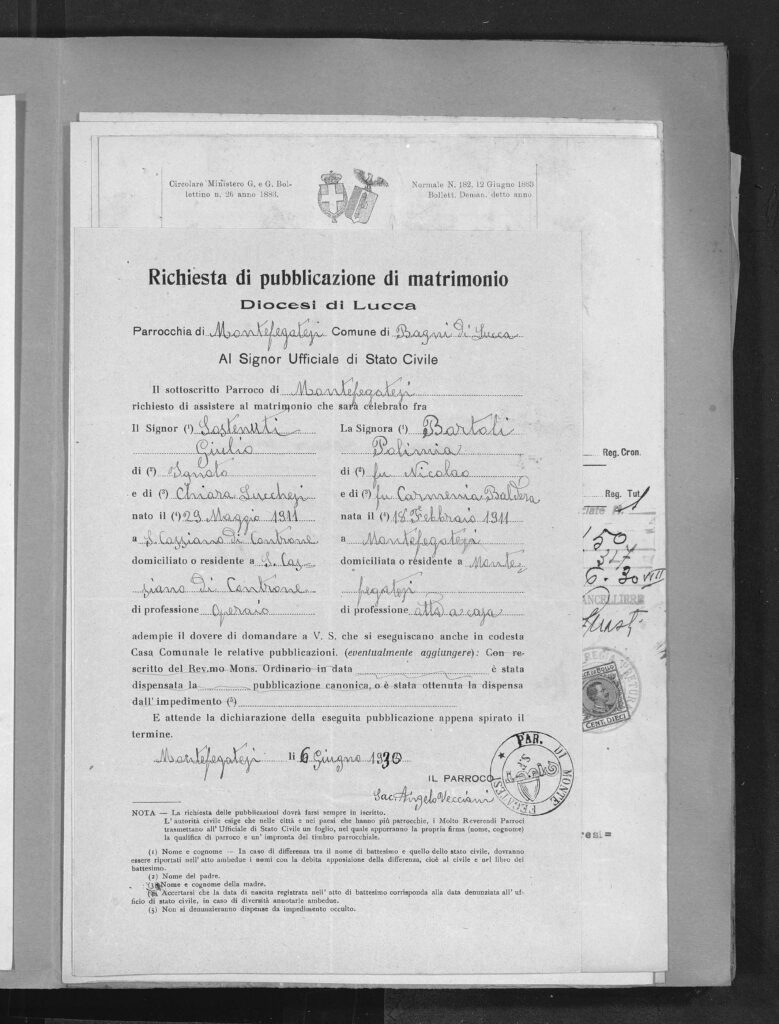
But on in the request for marriage banns (richiesta di pubblicazione di matrimonio), a name appeared that suddenly made the entire puzzle fall into place: Giulio’s biological mother was officially named for the first time as Chiara Lucchesi—the sister of Candido and Guido Lucchesi.
Unpacking the Story
Having the Lucchesi family fully mapped out prior to this discovery was essential to understanding what actually happened in 1930:
- The 1911 Stigma: When Chiara gave birth to Giulio in 1911 as an unmarried woman, registering him as a figlio di ignoti protected her from public disgrace and financial ruin in a small village, while allowing Giulio to be raised locally.
- The Legal Reality: Because Chiara had not formally acknowledged Giulio on his 1911 birth record, he remained legally parentless. When he turned 19 and wished to marry, the formal guardianship council was legally unavoidable.
- The Inner Circle: The Lucchesi family stepped up to handle the court proceedings for their ‘secret’ nephew. But rather than bringing in outside strangers to fulfill the second required legal signature, they turned to Ghilardo Illidi—their trusted companion who understood the reality of being a foundling better than anyone.
- Stepping into the Light: By allowing her name to be published on the final marriage banns in 1930, Chiara officially acknowledged her son as he embarked on creating a family of his own. This is the first time in my 15 years of doing Italian genealogy that a parent of a foundling has come forward in a public document.
Conclusion: Finding History in the Margins
This 1930 court file demonstrates how modern AI full-text indexing is changing genealogy. It allows us to find our ancestors not just in standard vital registers, but in the margins of other people’s lives—acting as guardians, witnesses, and loyal friends.
What began as a cold lead on an unfamiliar name ended up unlocking a 19-year-old family secret, illustrating the quiet networks of support, solidarity, and affection that held rural Tuscan communities together.
More from the blog…





Leave a Reply