Every genealogy project starts with a question. Mine began with a woman who carried the surname Domenici, and lived in San Cassiano di Controne in Bagni di Lucca, in the early 1800s. Yet, she was not born in San Cassiano – she had married into the village from surrounding villages, and little information was known about her origins.
That small mystery grew into something larger: a surname-mapping project to trace the Domenici families across Bagni di Lucca. My goals were twofold:
- To solve my own family mystery by identifying the parents and origins of Maria Domenici (ca. 1822-1858) who lived in San Cassiano during the first half of the 1800s.
- To show how anyone can build a surname study in an Italian village or comune.
What follows are the first five steps of my project. They took me three months (and counting), but they already show how surname mapping can expand far beyond your initial question and help you find the origins of those mysterious ancestors.

Start with What You Know
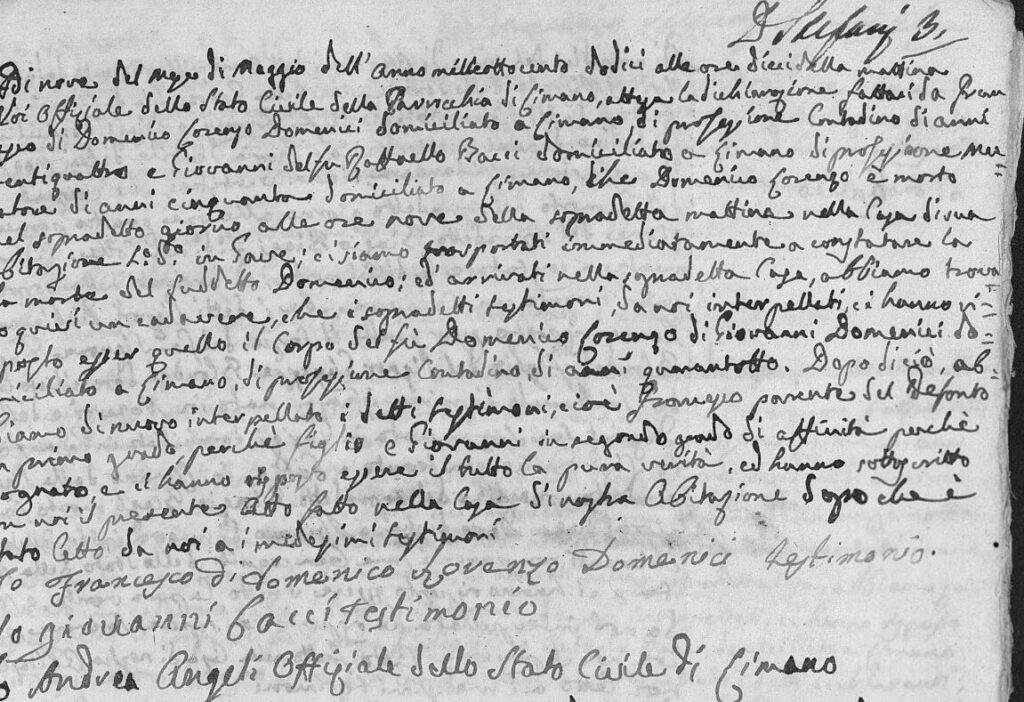
I began with Maria Domenici, who married Iacopo Bastiani (ca. 1831-?) in San Cassiano in October 1857. The birth record of their only child, Paolo, confirmed her surname and her father’s name (Andrea Domenici), and their marriage record confirmed her mother’s name (Giovanna Domenici). Yet, the registers gave no hint of her origins. Given that their marriage took place in San Cassiano, it was likely that she also originated from San Cassiano (marriages usually took place in the bride’s home parish), but through the parish household lists (Stati delle Anime), I could confirm that there were no individuals by the name of Domenici in San Cassiano in the early 1800s. I could also see, from reviewing civil records, that Domenici was not a native surname to San Cassiano. In other words, Maria Domenici was likely from another village than San Cassiano.
Here’s the takeaway: don’t assume a surname is native to the parish where you find it. In Tuscany, patrilocal marriage was the norm—women usually moved to their husband’s village, carrying their surname with them. Over time, this practice sprinkled “foreign” surnames into places where they had no roots.
For the Domenici family name, the surname appears most often in Limano and Benabbio, villages 17 km apart. From those centers, branches spread into Casabasciana, San Cassiano, Lugliano, Casoli—and even farther abroad to Spain and France.

Check Existing Family Trees (With Caution!)
My next move was to see what others had already pieced together. On FamilySearch, MyHeritage, Ancestry, and Geneanet, I found trees with Domenici branches. Some were useful, but many were riddled with errors: unsourced claims, missing dates, or merged individuals who were clearly separate people in the original records.
A particular challenge in Bagni di Lucca is the “black hole” between 1814 and 1849, when civil registration paused or parish registers weren’t digitized (yet). Any claims about births or marriages in those years can’t be checked online—you need to consult parish archives in person.
The point here is simple: online trees can provide leads, but they’re not evidence. Treat them like signposts—they might point you in a direction, but you still need to confirm every step in the original records.

Bring in Indexes
Since online trees weren’t enough, I turned to indexes—civil registrations, parish books, and even cemetery headstones. Databases like FamilySearch, and Antenati were invaluable for gathering these systematically.
If you’re doing this yourself, don’t just focus on your direct ancestors. A surname study means collecting every mention of the name: baptisms, marriages, deaths, witnesses, and godparents. In Italian records, witnesses and godparents were often extended family. Paying attention to them helps you see hidden connections between branches.

Collect All the Mentions—Every One
This step is the most time-consuming, but also the most important one. I built a spreadsheet logging every Domenici entry, grouped by event type:
- Births (1807–1813, 1850–1865, 1866–1900, etc.)
- Marriages (same years)
- Deaths (same years)
Indexes make the task manageable. Decade indexes (especially for deaths) save hours of page-turning, while annual indexes from 1866 onward (for births and marriages) let you skim for target surnames.
Here’s a crucial insight for Italian records: start with deaths and marriages, not births. Birth indexes only list the child’s surname (the father’s). If your target surname is the mother’s maiden name, it won’t appear—you’d have to read every single record. But women kept their maiden names until death, so marriage and death registers always show them.
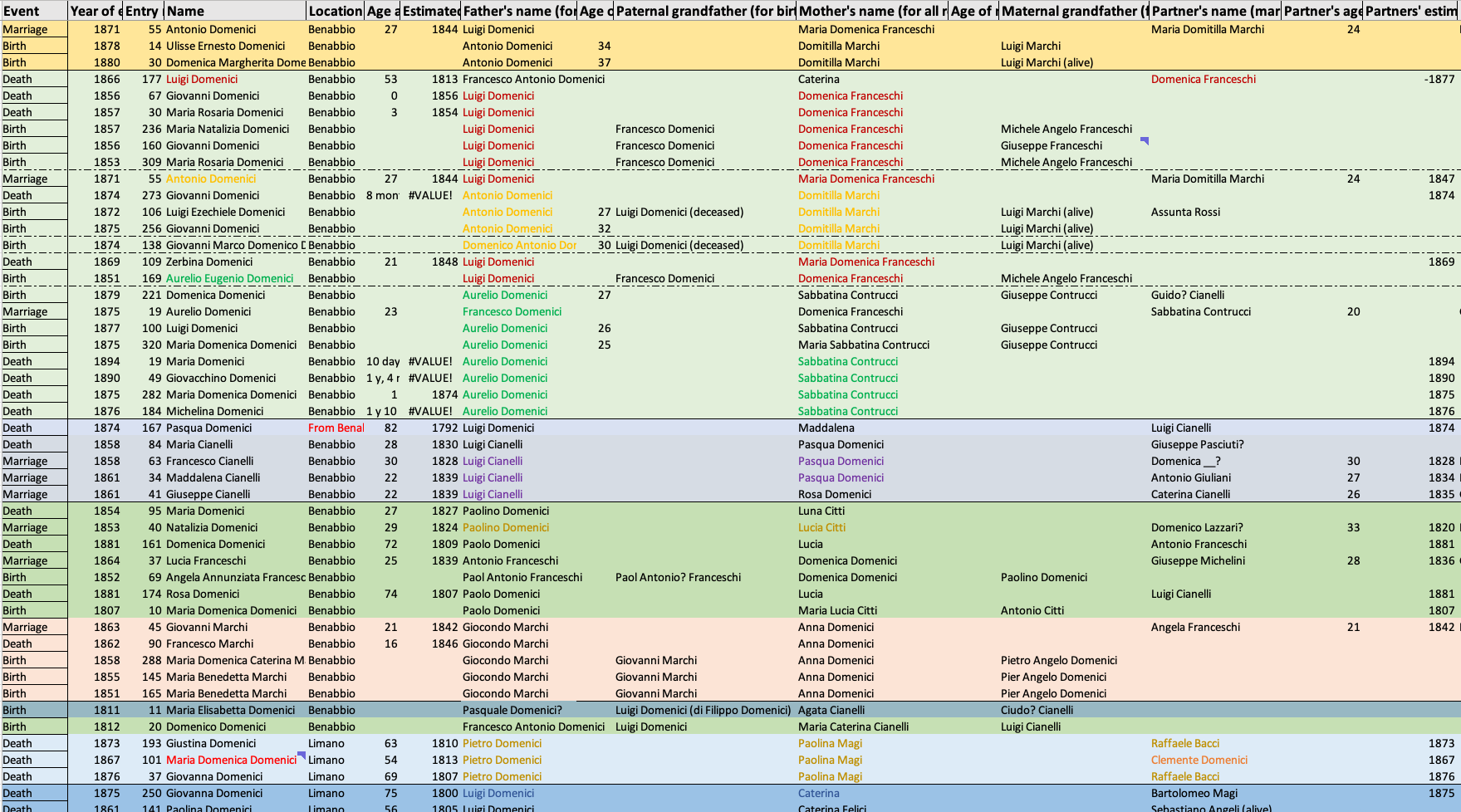
For example: if Caterina Domenici married into the Magi family, her children’s births would be indexed under Magi. Without her marriage or death record, you’d never know a Domenici line was hidden amongst the records belonging to the Magi family. As the spreadsheet grows, patterns will begin to emerge. The same witnesses will reappear. Certain villages will crop up again and again. Clusters of names will start forming. It will feel like assembling a jigsaw puzzle.

Organize and Build Connections
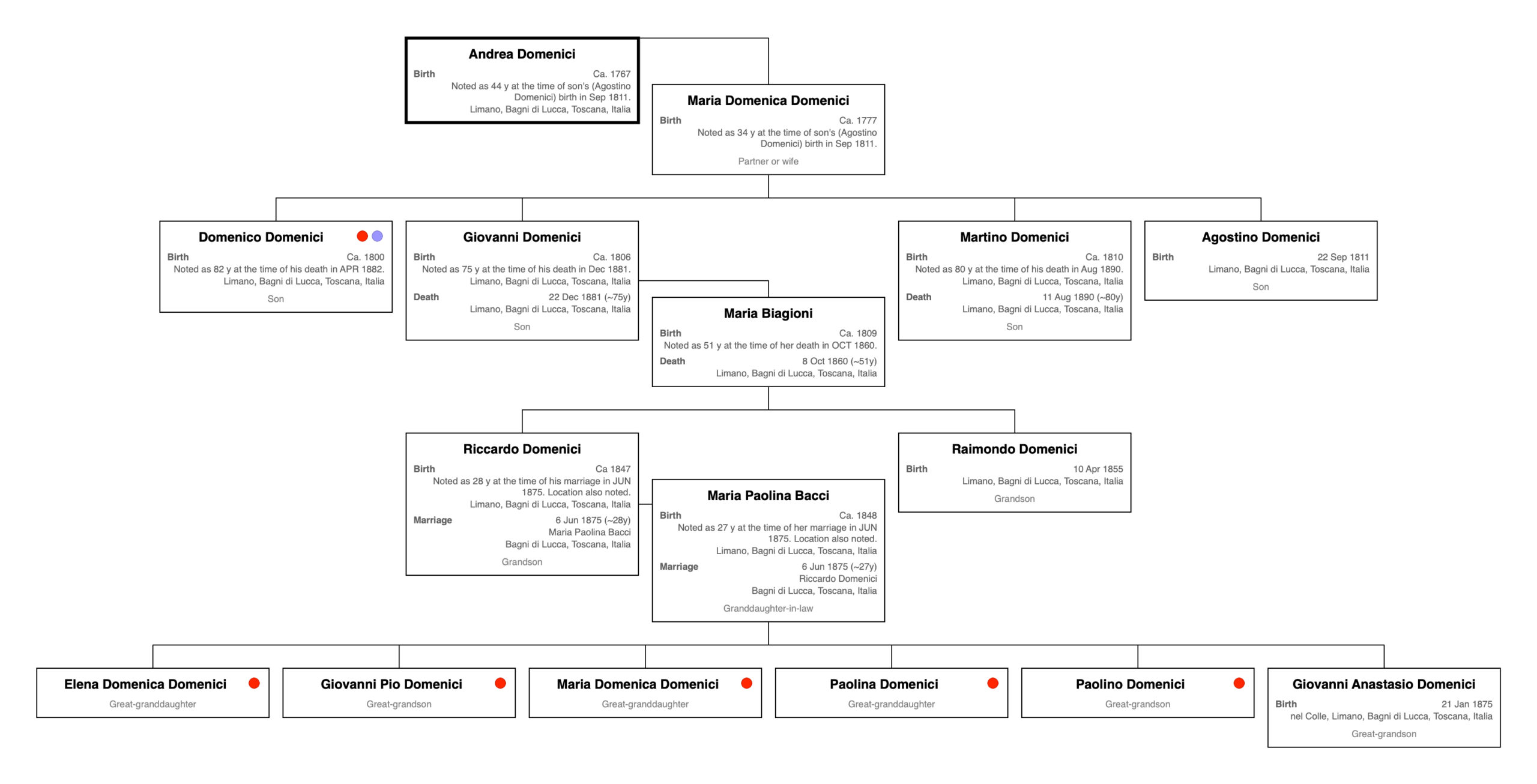
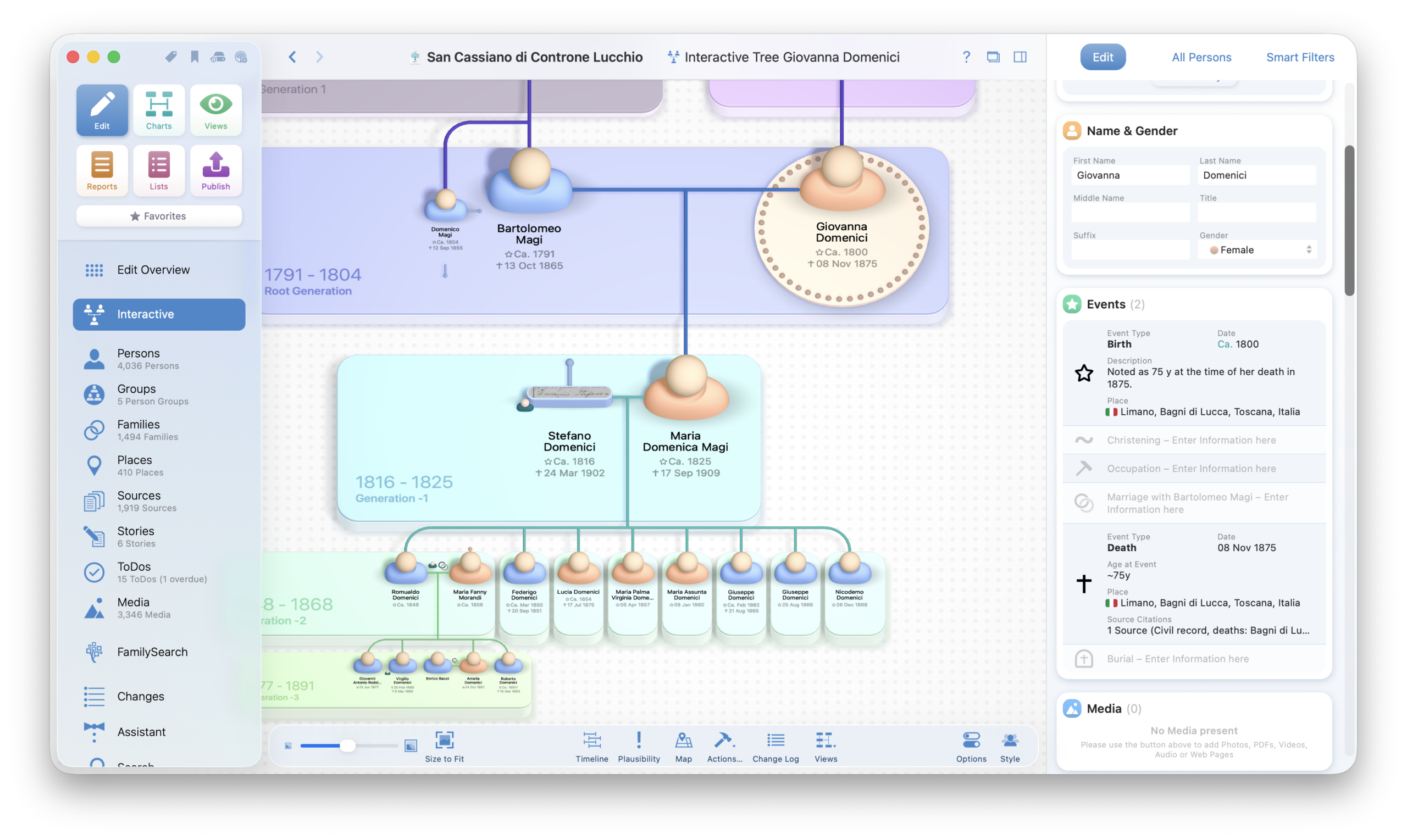
Once my spreadsheet was ready, I began importing individuals into genealogy software and building tentative family groups. At first, it felt mechanical: just typing in names and dates. But then, one marriage revealed parents, which linked to a birth, which was tied to a death. Suddenly, fragments turned into families, and families into networks spanning parishes.
This is the moment a surname project comes alive. You see how one Domenici branch in Limano connects to another in Pieve di Controne, and how links cross parish and village boundaries.
Do it yourself
Mapping a surname
Pick your surname carefully.
Some surnames are manageable; others are overwhelming. A quick way to check is by scanning indexes. If you find only a handful of events, like the Piccinini family of Palleggio (10–15 events in 100 years), you can map them in a couple of hours or days. If the surname appears hundreds of times, like Domenici (300-400 events), you’ll need weeks or months—but it’s still doable with structure and patience.
Collect every mention.
Don’t just follow your direct line. Baptisms, marriages, deaths, witnesses, declarants, godparents—every reference matters. Also, make notes when family relationships are mentioned explicitly. For instance, I’ve repeatedly seen records explicitly state “[Name], uncle of the deceased…” or “[name], sister of the father..”. These are ‘free’ clues that can save you a lot of time as you get to step #4.
Use a spreadsheet.
Record names, years, parishes, event types, parents’ names, partners, ages, and links to records. This helps you spot patterns and cross-check. Also have a column for comments or notes: here you can point out important clues you see.
Group into families.
Once you have enough events, nuclear families will appear. From there, you can connect them into larger trees across parishes.
Expect surprises.
A surname may belong to one extended family—or to multiple, unrelated ones. Sometimes what looks “widespread” actually traces back to a single origin.
Be careful with duplicates.
In small villages, names repeat constantly. Two men named Luigi Domenici might both marry women named Caterina. If one Caterina is listed only with her married name and the other with her maiden name, it’s easy to conflate them. Always check:
- parents’ names
- partner’s surnames
- middle names and nicknames
- exact birth and death dates
- Remember, it’s better to leave two possible duplicates separate until proven connected than to merge them prematurely.

Why it matters
Surname mapping does more than identify ancestors—it shows how families moved, married, and wove ties across the valleys of rural Tuscany. In Bagni di Lucca, where geography and parish boundaries often divided communities, kinship ties created the bridges that connected them.
For descendants of the Domenici—or anyone researching a Tuscan surname—this kind of work uncovers not just family lines, but the broader story of migration, kinship, and belonging.
That said, my own Domenici mystery isn’t solved yet. The three women I began with in San Cassiano remain difficult to trace back. Their given names and their parents’ names are simply too common, and so far the records don’t allow me to connect them securely to families in other villages.
Surname mapping is a long game. Sometimes answers come quickly; sometimes they take years. But with patience, the fragments do start to form a picture. And with the Domenici, the picture is still unfolding.
Leave a Reply