In Part 1 of this series, we looked at the underlying technology behind FamilySearch’s Full-Text Search—specifically how Handwritten Text Recognition (HTR) and inverted indexing allow a computer to search millions of handwritten pages in fractions of a second.
Understanding the tech is one thing, but how does it perform in practice when applied to a stubborn genealogical puzzle?
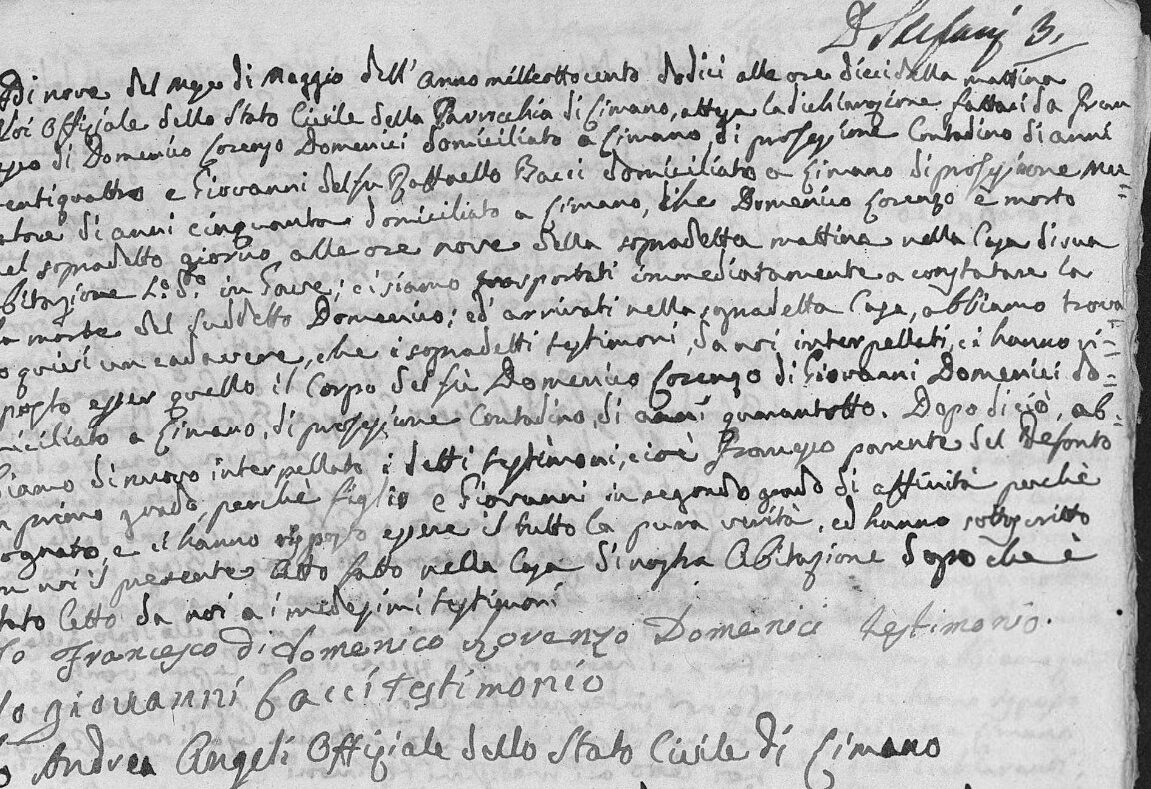
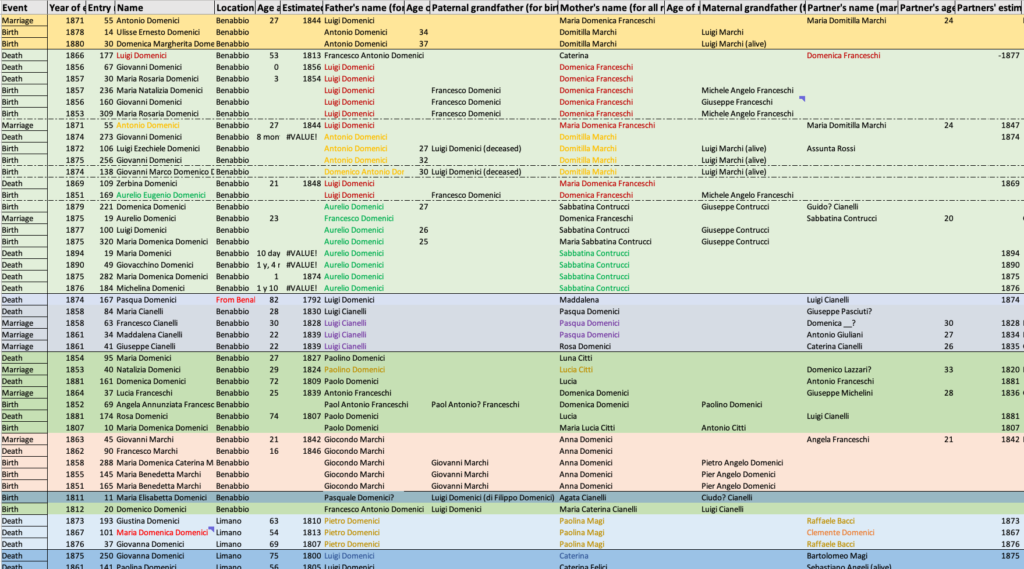
If you’ve been following my previous posts, you know all about my pet brick wall: the hunt for Andrea Domenici and his wife Giovanna, the parents of my 4x great-grandmother Maria Domenici (1822–1858). That search morphed into a massive mapping project of the entire Domenici surname in Bagni di Lucca, Italy. Up to this point, my research strategy involved brute-force indexing:
- 1866–1920: Extracted every Domenici mention from all available official civil indexes across birth, marriage, and death records.
- 1807–1813 & 1850–1865: Manually sifted through unindexed vital records to identify Domenici individuals across specific villages like Limano, Benabbio, and San Cassiano di Controne.
- Deep Extractions: Documented every Domenici listed as a witness, declarant, or indirect participant whenever identified.
- Cluster Building: Reconstructed tens of family clusters spanning 2 to 5 generations back to the mid-1700s, adding hundreds of individuals to the database.
- Genetic Connections: Integrated DNA results from my nonno, who has DNA matches with clear Limano ancestry. While no formal documentary connection has been completed yet, these family trees are built out in the database waiting for the final piece of the puzzle to fall into place.
However, after hearing about FamilySearch’s Full-Text Search on the Research Like A Pro podcast, I realized this tool was made for a project like mine. It offered a way to instantly search unindexed records for references to Andrea Domenici where he wasn’t the primary subject, such as marriage supplements or witness lists, without flipping through digital microfilms image by image. Plus, it served as a perfect pilot test for how well the AI handles Italian handwriting from Bagni di Lucca.
The Search Setup
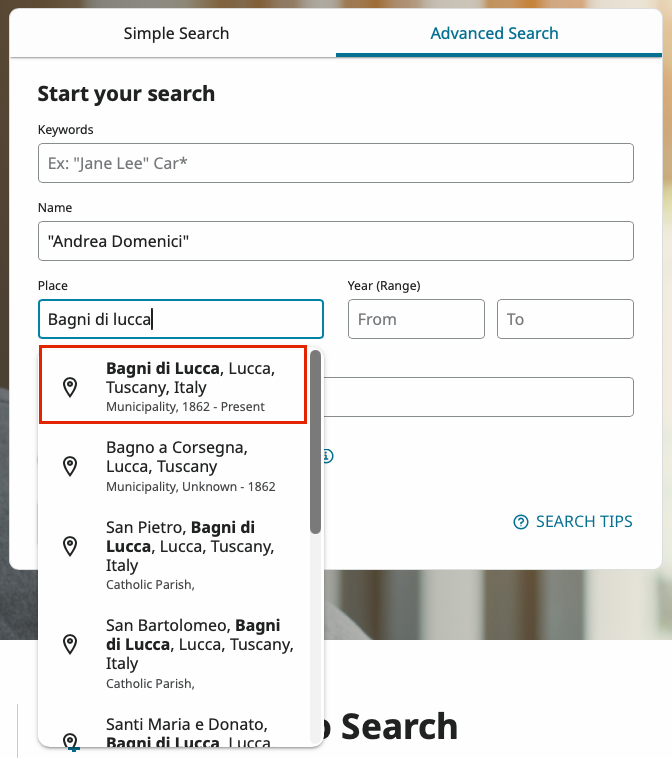
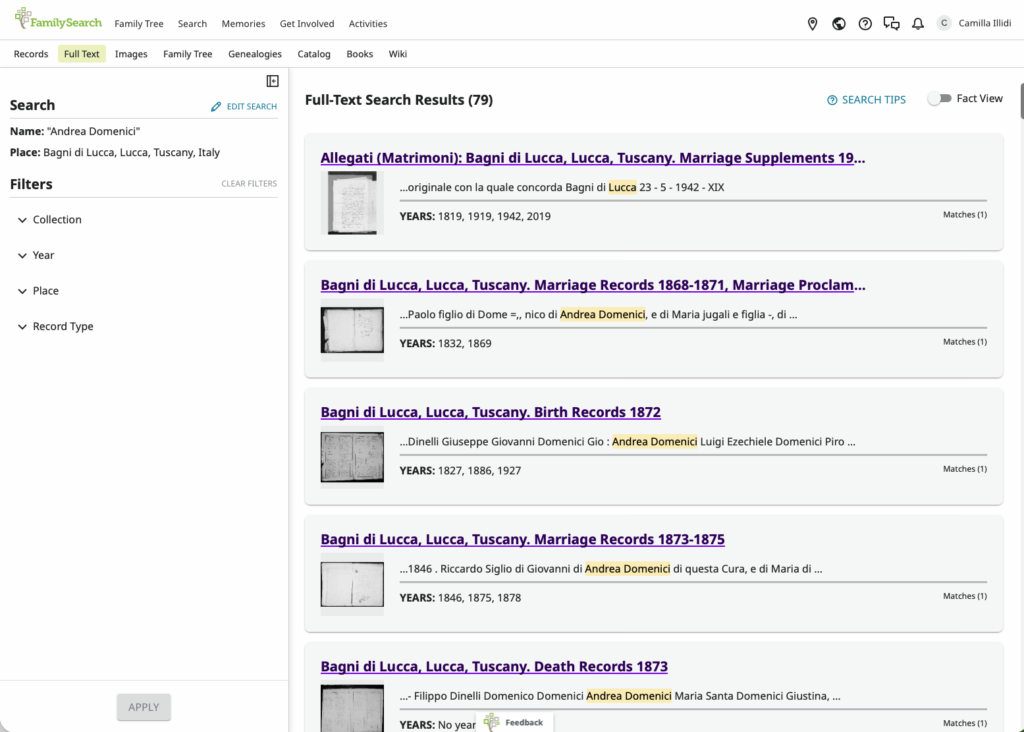
To keep the query targeted without artificially strangling the results, I used the Advanced Search feature with a simple setup:
- Name Field: Entered
"Andrea Domenici"as an exact phrase so the AI searched for both names together, rather than returning every random “Andrea” or “Domenici” on a page. - Place Field: Selected
Bagni di Lucca(using the system’s auto-suggested municipality, 1862–present designation). - Filters: Left the year range open and avoided adding extra keywords to prevent filtering out unexpected hits.
What the AI Found
The query returned 79 total hits across Tuscany, 10 of which were tied directly to Bagni di Lucca (with the rest scattered across nearby communes like Lucca, Camaiore, Pescaglia, Seravezza, and Stazzema). Here is what turned up in those 10 local results:
- Known Individuals Reconfirmed: All 10 mentions traced back to Andrea Domenicis already mapped in my database. No brand-new, unknown Andreas appeared in the municipality (which was good news—it proved I hadn’t missed anyone in my prior work!).
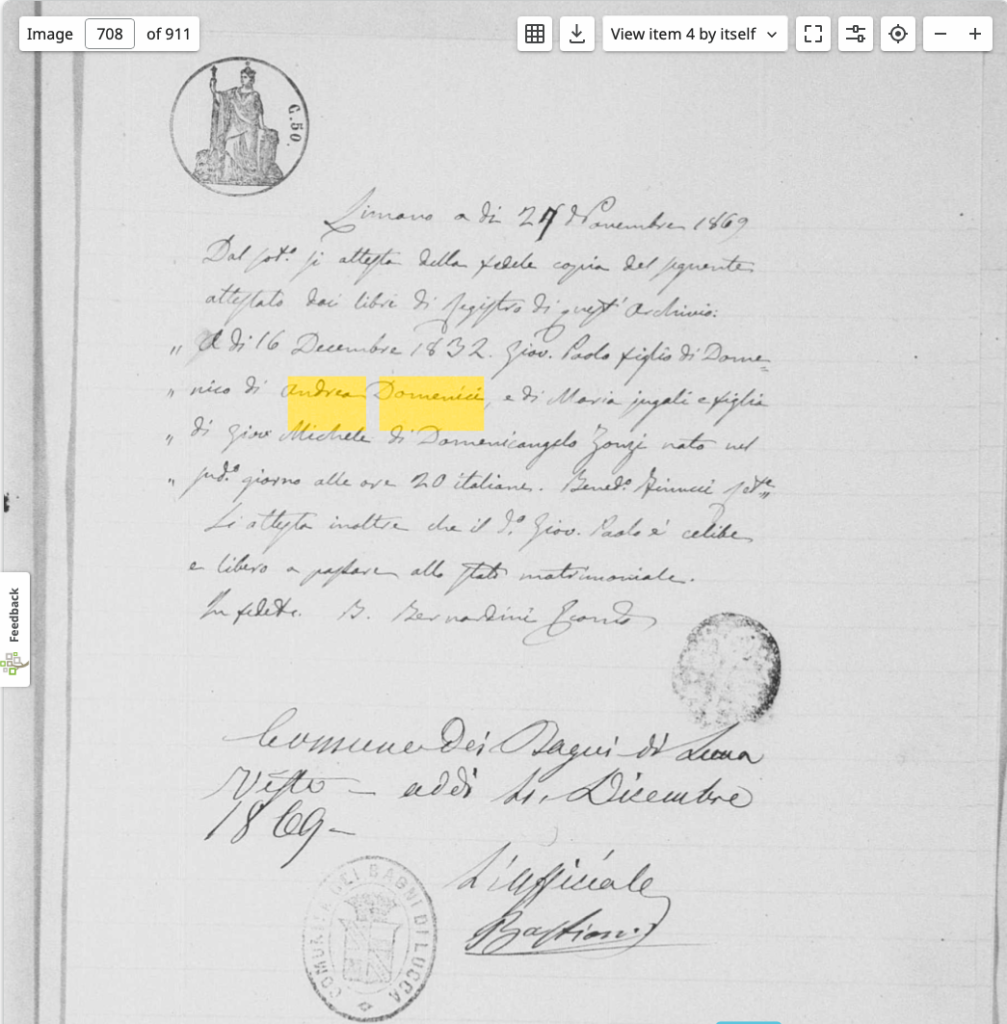
- Hidden Gold in Marriage Supplements (Allegati): Four hits pointed to marriage supplements for grandchildren of various Andrea Domenicis:
- A grandson: Romualdo Domenici (son of Stefano, son of Andrea).
- A grandson: Riccardo di Giovanni (son of Andrea Domenici).
- A granddaughter: Palma Virginia Domenici (daughter of Stefano, son of Andrea).
- A grandson: Giovanni Paolo di Domenico (son of Andrea Domenici).
- Unindexed Minor Records: A death record for a child named Andrea Domenici (born 1872, died 1873) whose birth and parentage were already in my database, but whose brief life span was now fully documented.
- Late Transcriptions: A birth record from 1924 where an Andrea Domenici served as a witness, captured in an official supplement transcribed in 1942.
- Standard Index Hits: Three results matched index entries already present in the database from my previous searches.
The Real Value: What I Learned
Even without discovering a brand-new “Andrea,” the search yielded significant breakthroughs for my wider family reconstruction:
Uncovering Maiden Names: I confirmed two mothers’ maiden names from original birth record transcripts embedded in those supplements—women who had previously only appeared under their husband’s surname or with missing parentage details.
Bridging the 1813–1850 Gap:
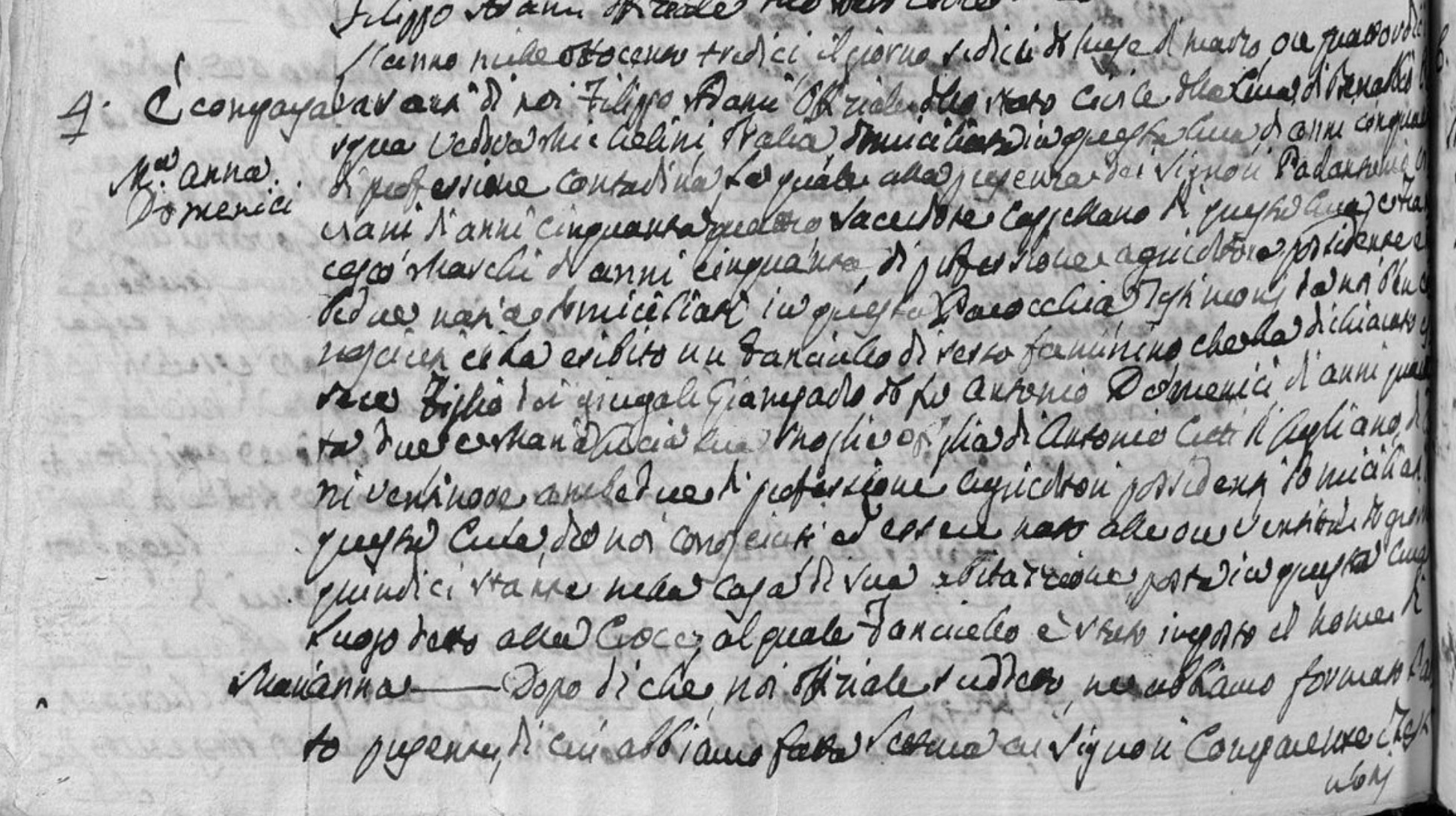
Italian civil registration gaps can make pinpointing birth dates difficult. Because marriage supplements frequently include transcripts of older birth records, I extracted six exact birth dates between 1832 and 1848 that were previously unknown.
Solidifying Relationships: The search verified several inter-generational links across my existing family clusters.
Did It Break the Brick Wall?
Strictly speaking, no. My target, Andrea Domenici, lived between at least 1800 and 1822 (when his known daughter, Maria Domenici, was born in 1822). The current implementation of FamilySearch Full-Text Search primarily covers Italian civil records from 1866 to 1955, placing his own vital events outside the tool’s current scope (except perhaps for a late death notice). For now, I am most likely to find transcripts and records pertaining to his children and grandchildren.
However, the tool significantly enriched my research into his FAN club (Friends, Associates, and Neighbors). I gained critical context about Stefano Domenici—the son of the most plausible candidate to be Maria’s father, and a potential brother for “my own” Maria Domenici.
While Maria Domenici and her family could theoretically have originated outside Bagni di Lucca, local migration patterns show other women moving from Limano to San Cassiano during that era. Given that Domenici was a prominent surname in Limano—a link reinforced by genetic genealogy—expanding this cluster brings me one step closer to proving the connection.
As FamilySearch continues to expand its AI transcription pipeline into earlier record sets, full-text search will undoubtedly become an essential tool for breaking down historical brick walls.
Read more from the blog…



Leave a Reply