
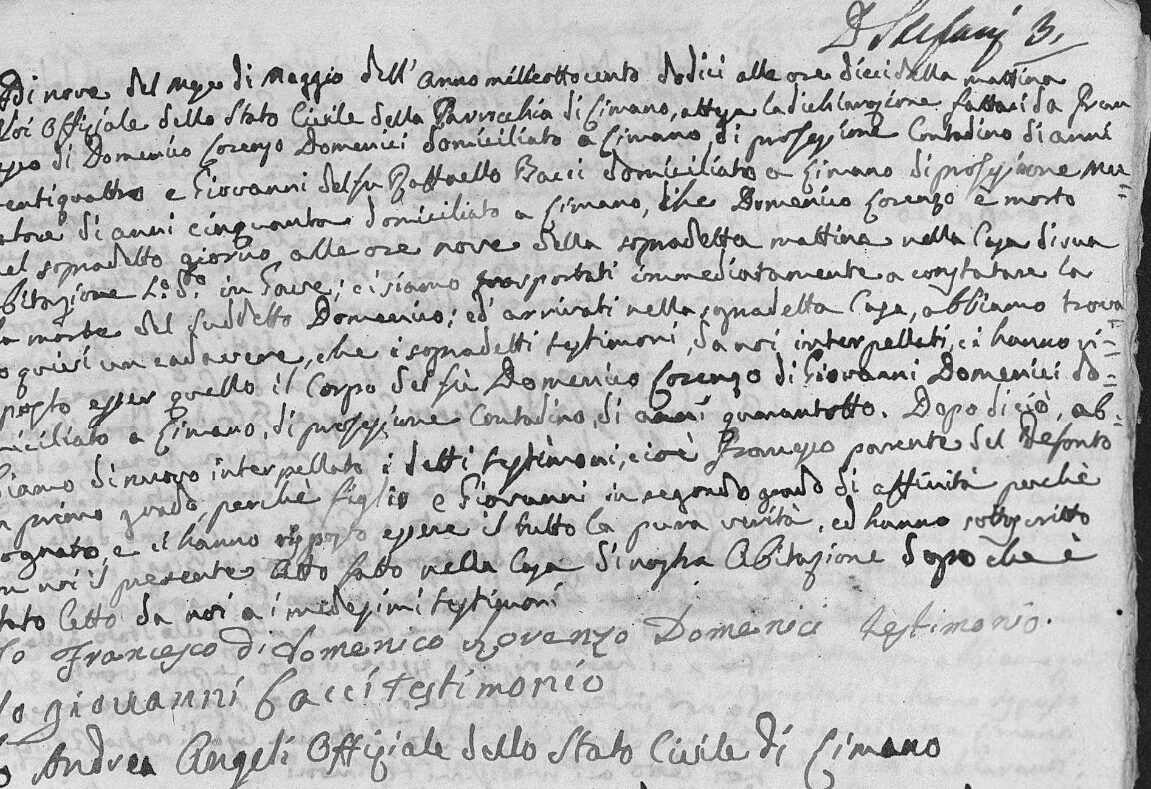
Over the past year, work has been undertaken on a surname-mapping project focused on the Domenici families of Bagni di Lucca.
The project has been documented in a three-part blog series, in which the methodology and early findings are outlined. These posts trace the development of the study, from an initial research question to the emergence of wider family networks across multiple villages.


To date, more than 320 events have been identified in civil records, resulting in approximately 250 new individuals being added to the database. The majority of these entries are connected to the villages of Limano and Benabbio, both of which are proving central to understanding the distribution of the Domenici surname in the area.
In addition to the Domenici, a number of associated surnames have been identified through marriages, witnesses, and extended family connections.
From Limano, these include:
Bacci, Licci, Morandi, Tarlattini, Zonzi, Magi, Storti, Nerici, and Angeli.
From Benabbio, the following surnames appear:
Michelini, Giusti, Cianelli, Franceschi, Marchi, and Giuliani.
The individuals identified so far span a broad chronological range, with births (estimated or recorded) dating from 1734 to 1910. As is common in projects of this scale, some individuals currently have limited information and may represent duplicate entries. These have been retained as separate individuals pending further confirmation.
Although the original research question—the precise origins of Maria Domenici—has not yet been resolved, a clearer picture of the surname’s distribution is beginning to emerge. The Domenici appear to have strong roots in Limano and Benabbio, with connections extending into surrounding villages, including San Cassiano.

The project remains ongoing. Future work will focus on refining these connections, consulting additional archival material, and exploring further methods—including DNA analysis—to help address remaining uncertainties. Further details on the approach and findings can be found in the three-part blog series, where the surname-mapping process is described step by step. One blog post is already out, and can be found here, the others are scheduled for April and May.
In the next blog post, a practical step-by-step guide will be introduced for those wishing to map a surname within their own area.
You might also be interested in some of our other stories…
-
Unlocking a 1930 Family Secret: Foundlings, Guardians and the Power of Full-Text Search
Genealogical research in Tuscany often follows a familiar pattern: birth, marriage, and death records that tell a straightforward story. But every so often, you stumble across a set of documents that completely changes what you thought you knew; not just about a family tree, but about how a community protected its own. Recently, while using…
-
How FamilySearch full-text search is helping me break down brick walls in Bagni di Lucca – Part 2
In Part 1 of this series, we looked at the underlying technology behind FamilySearch’s Full-Text Search—specifically how Handwritten Text Recognition (HTR) and inverted indexing allow a computer to search millions of handwritten pages in fractions of a second. Understanding the tech is one thing, but how does it perform in practice when applied to a…
-
Update: September 2026
It’s hard to believe four months have passed since our last check-in in June 2026, but the site has seen a flurry of activity in that time. We’ve published four new deep-dive blog posts, exploring everything from leveraging FamilySearch’s game-changing full-text search and MyHeritage DNA mapping to discovering what famous visitors like Mary Shelley revealed…
-
How FamilySearch full-text search is helping me break down brick walls in Bagni di Lucca – Part 1
If you’ve used FamilySearch’s Full-Text Search feature, you know it feels like magic. For decades, finding ancestor details in unindexed records meant clicking through digital image rolls page by page; essentially flipping through thousands of dusty microfilm frames on your computer screen. Before then, you had to physically visit the archive where the microfilms were…
-
How DNA can lead you to Lucca
How can a DNA test look at a sample and point to something as specific as a province, valley, or local community? I did the digging, and here’s what I figured out. Family historians know the satisfaction of watching evidence slowly arrange itself into a coherent picture: a baptism here, a marriage there, a familiar…
-
What we can learn about our Bagni di Lucca ancestors from Mary Shelley and her circle
Summer, 1818 For those of us with roots in Bagni di Lucca and the slopes of Prato Fiorito, the summer of 1818 provides an unusual historical perspective on the valley through the writings of several well-known English visitors. In the summer of 1818, Percy Bysshe Shelley, his wife Mary — author of Frankenstein — together with Claire…
Leave a Reply