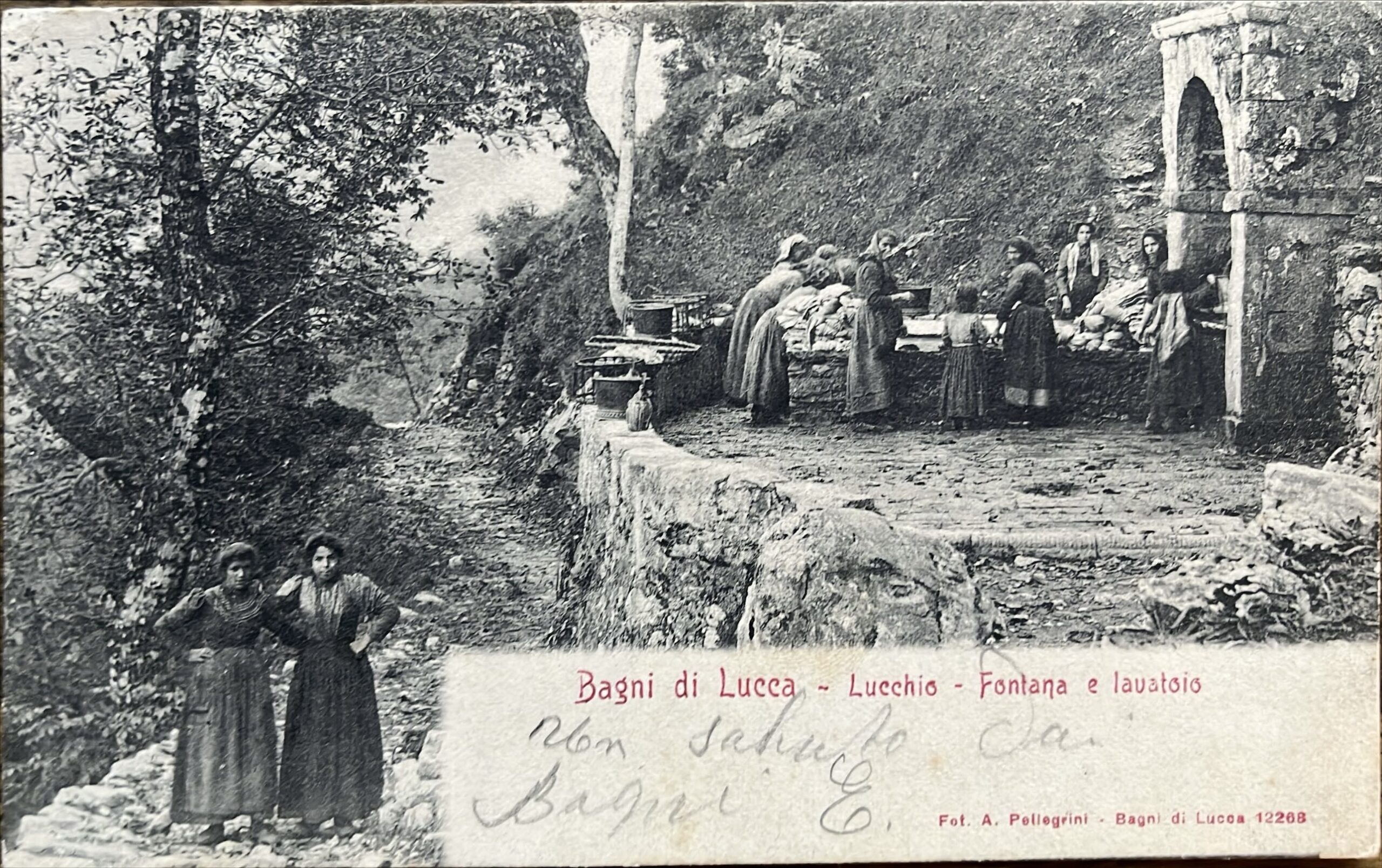
The women who shaped our villages.
In 19th-century Tuscany, it was almost always the woman who moved. When she married, she left her birth village behind and started a new life in her husband’s community; sometimes just a few valleys away, sometimes much further. This tradition, known as patrilocal marriage, was common throughout rural Italy, and in places like Bagni di Lucca, it left a lasting mark.
But women carried more than their dowries when they moved. They brought recipes, farming know-how, naming traditions, dialects, sewing patterns, and even superstitions and medical advice passed down through generations.


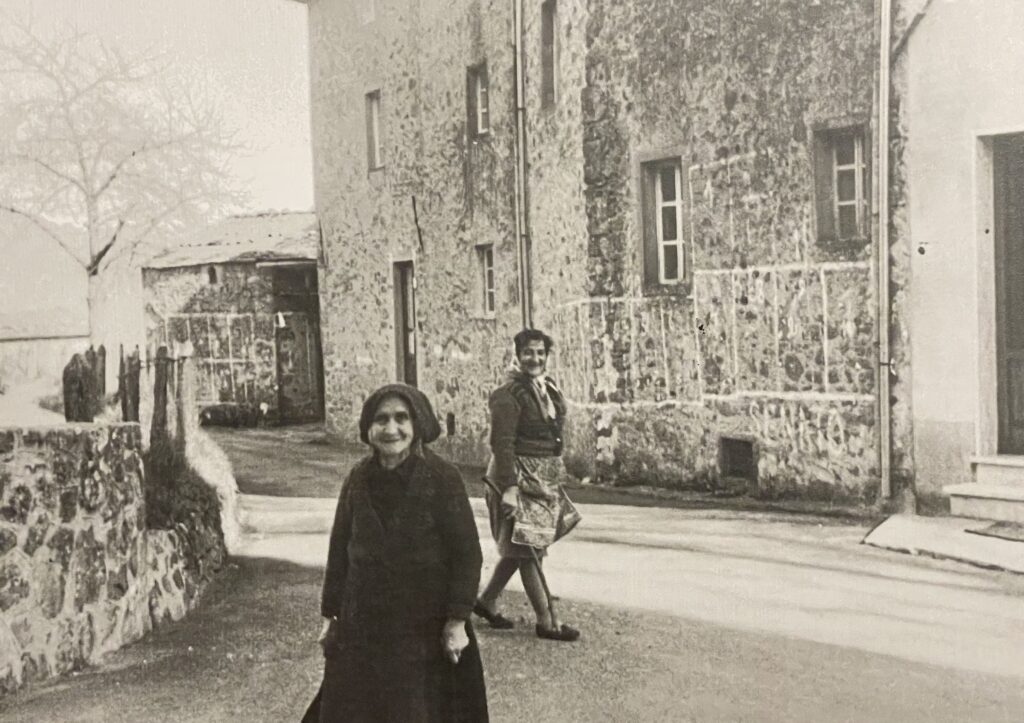
The inspiration for this blog post began while tracing my own family tree. Among the many women who moved across these mountains, my fourth great-grandmother was particularly interesting: Giuditta Signorini (1823–1890). She was born in Tobbiana, a village in Montale in Pistoia, and around the 1850s she married into San Cassiano di Controne — a village approximately 70 km from her own. Her story stood out because she didn’t just relocate; she left visible traces in her new home, in ways that kept showing up in the local records.
But Giuditta wasn’t alone. Another fourth great-grandmother of mine, Maria Giovanna Pacini (1836–?), left Lucchio for San Cassiano around 1855. Others from Pieve di Controne settled in Palleggio; women from Casabasciana moved to Lucchio; brides from Limano began new lives in Palleggio, Casabasciana, and Cocciglia. These women weren’t just names in registers — they were bridges between villages, cultures and traditions. And they made me wonder: How did they meet their husbands? What made them move? What were their lives like?

Where Did They Meet?
For people from different villages to marry, they had to meet first — and that wasn’t always simple. Life in the Tuscan mountains could be isolating, but rural communities created moments for connection. Weekly markets brought villagers together from up to 15 kilometers away. These were economic hubs, but also social spaces where glances and conversations could lead to something more. Religious festivals and pilgrimages served a similar role: local saints’ feast days, processions, and events along routes like the Via Francigena gave people a reason to travel — and a chance to meet outside their home parish. Even the agricultural calendar played matchmaker: seasonal work, especially during the grape and wheat harvests under the Italian sharecropping system (mezzadria), could bring laborers from different villages together in the fields. These gatherings weren’t just practical; they were social crossroads.
And many of these encounters led to marriages — but where the wedding took place and where the couple settled tells us even more about the social patterns of the time. In a unique study of Casalguidi, a village in Pistoia just a 75 min drive from Bagni di Lucca, researchers examined over 1,000 marriages between 1820 and 1858[i]. Their findings speak volumes: when a Casalguidi man married a woman from another village, 96.6% of these couples settled in Casalguidi. But when a Casalguidi woman married a man from elsewhere, only 24.8% stayed in the village — with the rest moving to the husband’s home or a completely new location. These numbers underscore a defining feature of rural Tuscan life: patrilocal marriage. For most women, marriage didn’t just bring a new husband — it meant leaving home behind and creating a brand new life.

Map of 45 marriages in Bagni di Lucca (spanning 150 years, from 1750 to 1900) where the woman moved to her husband’s village. Pins mark villages, with each colour showing the bride’s home village. Colored lines connect the bride’s village to the village she moved to, using the same colour for easy tracing.
A Marriage Was Just the Beginning
Marriage didn’t just mean moving to a new house; it meant stepping into a new identity and role. A bride had to integrate into her husband’s household, adapt to unfamiliar customs, and build a place for herself. But she also brought her own traditions — and sometimes her arrival marked the start of something bigger.
In fact, patterns in the records show that patrilocal marriages were rarely isolated events. In San Cassiano, for example, I found repeated instances of women from Lucchio, Limano, and Palleggio marrying into the village. This wasn’t coincidence. Once one family forged a successful connection, others often followed, creating marriage “chains” that linked villages together.

Take Maria Giovanna Pacini (1836–?) from Lucchio, my fourth great grandmother who I mentioned in the introduction. In 1855, she married Bartolomeo Fabbri (ca. 1836–1879) from San Cassiano in Lucchio (see Figure above). Just a few years later, in 1858, Maria Antonia Pacini, likely a relative, also married into San Cassiano when she married Domenico Barsetti (ca. 1835–?). Another striking case involves the Piccinini family of Palleggio: across three generations and 40 years, three women — an aunt and two first cousins — all married men from San Cassiano; two of whom were also related (see figure below). These weren’t isolated marriages; they were part of broader kinship strategies.
Why did these patterns matter? They strengthened family networks across valleys, helping households secure labour, share resources, and even improve social standing. Sometimes, daughters who married further afield received slightly larger dowries — perhaps to ease the transition or signal goodwill to their new families. These choices were practical as much as personal, shaping the social fabric of the region one marriage at a time.


What the Women Brought With Them
What would women bring with them when moving? In fact, Italy has a long and unique tradition with wedding chests, also known as cassoni, that were given to new brides to take their new home to be used for storage and even seating[i]. While these wedding chests could be elaborately decorated with poetry by famous poets such as Dante, gold enamels, wooden carvings of mythic tales or Roman scenes, ‘normal’ farmers who were not a part of Florence’s social elite exchanged more humble wedding gifts. For instance, old paintings of Tucan migrants often depict simple wooden chests and metal buckets, while inventory lists from deceased household heads denote household items such as linen and linen chests, scarves, and furniture, such as beds and cribs[ii]. For farmers and day labourers, these items were also essential components of a dowry: While the social elite transferred money and even property as part of a marriage settlement, the dowries of lower social classes — likely also those among Bagni di Lucca’s farmers and day labourers — would be useful household items or livestock[iii]. In the case of Giuditta Signorini, who moved nearly 70 km – or a 13 hr journey by foot – from her native village of Tobbiana, it is likely that she received a slightly larger dowry to compensate for emotional and social distances[iv]. In a social system where women were prevented from inheriting property, even from her own father or husband, a financial dowry was an essential security in widowhood in case something happened to her husband[iv]. Yet, in a farming society where dowries primarily consisted of household items, it’s easy to see the risk many women took when marrying a husband from another village.
Beyond the Dowry: The Invisible Exchange
However, when a woman left her home village for marriage, she didn’t arrive empty-handed — even if her dowry was a few simple household items. She brought with her a lifetime of inherited traditions, subtle technologies, and ways of seeing the world that gradually reshaped the communities she joined.
These were the invisible exchanges; less documented than the linens and coins in the dowry chest, but no less significant[i]. Here are some important skills she likely brought:

Skills
A woman from a wine-producing region might share vine pruning techniques or new ideas for fermentation and storage. Another, from a wool-producing family, could introduce spinning or weaving patterns specific to her home village.
Plant knowledge
Some may have brought seeds from home gardens, consisting of herbs, vegetables, or flowers that thrived in their old village but were novel in the new one. Alongside this came agricultural know-how about planting cycles or pest deterrents, shaped by generations of lived experience.
Medical knowledge
Traditional medical knowledge also traveled with women: the use of herbs to treat fevers, midwifery techniques, or rituals to protect newborns. These practices, rooted in folklore and necessity, were vital in isolated rural communities with little access to formal healthcare and in a time when the medical field was highly experimental and inaccessible in isolated villages.
Culinary traditions
Culinary traditions crossed valleys and mountains too. Women brought recipes, food preservation methods, and feast day customs that slowly altered local tables. For example, a particular method for preparing minestra di pane, the bread soup common in the mountains around Pistoia, might have found its way to the Fabbri family dinner table in San Cassiano thanks to a recipe Giuditta Signorini had learned in her own childhood home in Tobbiana.
Naming traditions
Women also carried naming traditions, often rich with religious or family meaning, which could subtly reshape local naming patterns over generations. Again, we can use Giuditta Signorini as an example. After marrying into San Cassiano in the 1850s, she gave her thirteen children names rarely seen in the village before: Gugliemino, Maria Felicita Eufrosina, Maria Anna Cecilia, Maria Teodoria, Maria Graziosa, Maria Ermenegilda Nicomede, and Maria Giovanna Carmelina. These names and name combinations weren’t just decorative; they carried memory and meaning. And what’s even more telling is that they persisted across generations, appearing not only in Giuditta’s own ancestry in Tobbiana, but again in her grandchildren in San Cassiano.

These kinds of contributions — practical, spiritual, medicinal, culinary, familial — rarely show up in marriage registers or legal documents. Yet they are central to understanding how women helped shape the cultural landscape of rural Tuscany. In more elite or literate circles, women often compiled recipe books that blended culinary knowledge with healing practices, preserving generations of female wisdom in writing[v]. But in a primarily illiterate society like 19th-century Bagni di Lucca, this kind of knowledge couldn’t be passed down through notebooks or ledgers. Instead, it travelled with the women themselves — embedded in memory, carried in custom, and shared through practice. Each woman who married into a new village brought with her the living fabric of another place — and in doing so, stitched together a broader regional identity that transcended borders, parishes, and surnames. Marriage wasn’t just a social contract; it was a channel for cultural continuity.
Caption
It could be a difficult life on the Italian countryside – especially for women who had moved to a new, unfamiliar village. By: Riis, Jacob A., Public domain, via Wikimedia Commons. From: https://commons.wikimedia.org/wiki/File:Riis,_Jacob_A._-_»Zuhause_eines_italienischen_Lumpensammlers«_Jersey_Street_(Zeno_Fotografie).jpg
Connections That Didn’t Break
Even after moving, many women maintained deep ties to their birth families. Civil birth records often reveal interesting details: a woman giving birth in her husband’s village, with a witness from her own village present—a father, brother, or sister. These appearances weren’t just formalities. In a mostly illiterate world, they spoke volumes. News traveled fast, and kin made the journey to support one another.
An example of this can be seen in the figure below, where the married couple Giovanni Silvio Barsetti (1819-1855) and Gesualda Piccinini (?-after 1855) registered the birth of their son Giovanni Domenici Barsetti in February, 1854. One of the two witnesses is Annunziata Piccinini, Gesualda’s own sister, who had taken the trip to San Cassiano from Palleggio to act as witness. A longer journey was made by Mariano Pacini, who travelled from Lucchio to San Cassiano in November, 1858 to be present for the birth registration of a likely nephew, Giuseppe Salvatore Barsetti, whose likely sister, Maria Antonia Pacini, was married to Domenico Barsetti of San Cassiano.
Caption
Festive rest in Guzzano, late 1950s Filumena Morelli Taliani, Eletta
Giannini, Santina Nicolai. From: Ricordo di un pievano, Don Elio Carlotti”, Parrocchie di Pieve di Controne e San Gimignano di Controne. Made available thanks to Alessandra Rossi.
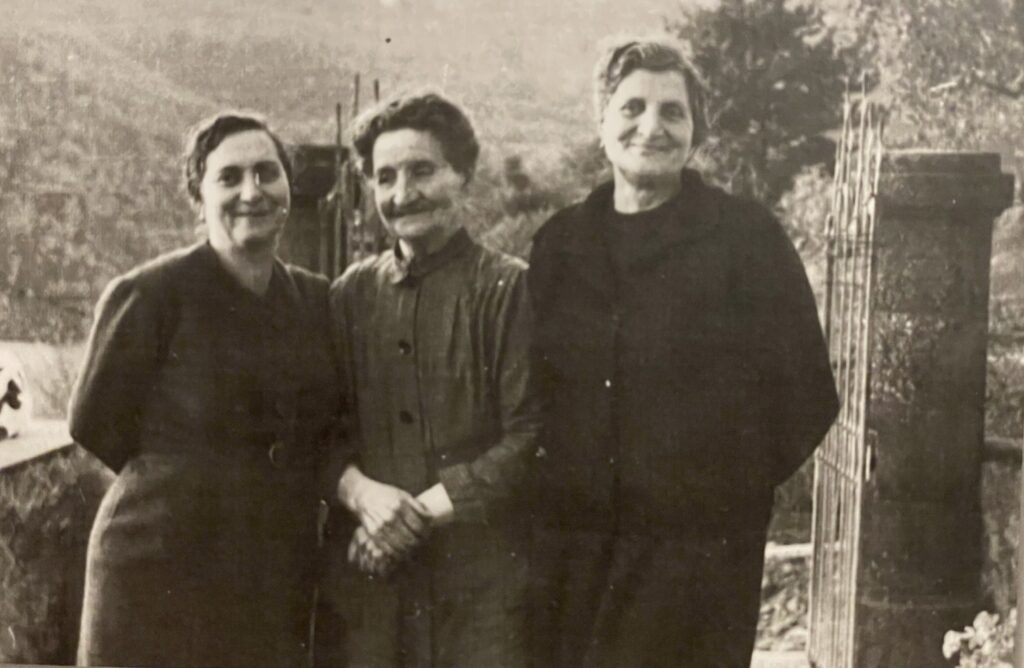


Anthropological studies of modern patrilocal societies show how women living away from their own family rely heavily on those remaining connections, and how it could be difficult to settle in a new village far away from one’s own[i]. In fact, in these studies, it is well-documented that women who moved to her husband’s village received less family support in childcare and had smaller social networks. Actually, the social network was smaller the further away the woman lived from her own family, and was critically disadvantaged if something happened with her husband (e.g., severe illness, injury or death).
Reduced access to natal support
Women living far from their birth villages often had fewer direct ties to their parents, siblings, or extended family for childcare, emotional support, or community advice. This dynamic mirrors how Tuscan brides, once relocated to their husband’s village, needed to find new forms of social connection.
Importance of extended family networks
Research shows that women with stronger connections to their own families, either through visits, letters, or network visits as those mentioned above, were more likely to participate in other social networks beyond their immediate household. In rural Tuscany, maintaining connections to one’s own family likely translated into famil members traveling for births, marriages, market days, or church festivals, as shown above.
Emotional and practical reliance on family ties
Even within patrilocal residence norms, women gravitated toward their birth families for emotional support, childcare, and crisis help. Tuscan women likely did the same when their sisters, brothers or fathers traveled to serve as witnesses at birth registrations or marriage ceremonies.
Why It Matters
If you’re tracing ancestry in Tuscany, follow the women. They are often the key to uncovering new villages, hidden branches, and unfamiliar surnames. But their importance goes beyond genealogy. These women show us that rural culture didn’t survive by staying static — it grew through exchange. Communities were connected because women carried traditions, skills, and family ties from one place to another.
When a woman moved for marriage, she didn’t just change address. She brought pieces of her old life into a new one and, in doing so, she helped shape the village she joined.
So if you find a woman in your tree from “somewhere else,” look closer. She may have carried more than her dowry. Just as Giuditta Signorini left Tobbiana for San Cassiano and left her mark in names, customs, and family ties, other women in your tree may have done the same.

Sources
[i] Breschi, M., Fornasin, A., Manfredini, M., & Zacchigna, M. (2009). Family Composition and Remarriage in Pre-Transitional Italy: A Comparative Study. European Journal of Population / Revue Européenne de Démographie, 25(3), p. 277–296. http://www.jstor.org/stable/40271616
[ii] First Art Museum (2018) Life, Love & Marriage Chests in Renaissance Italy. Accessed August 5, 2025. Available from: https://fristartmuseum.org/exhibition/life-love-marriage-chests-in-renaissance-italy/
[iii] Refashioning the Renaissance (2021) Did ordinary Italians have a ‘Renaissance’? Discover how artisans lived and connected with culture from my new book! Accessed August 5, 2025. Available from: https://refashioningrenaissance.eu/did-ordinary-italians-have-a-renaissance/?utm_source=chatgpt.com
[iv] Micheletto, B. Z. (2011) Reconsidering the southern Europe model: Dowry, women’s work and marriage patterns in pre-industrial urban Italy (Turin, second half of the 18th century). The History of the Family, 16(4), p. 354-370. http://doi.org/10.1016/j.hisfam.2011.08.005
[v] Barbagli, M. (1991). Marriage and the family in Italy in the early nineteenth century. In J. A. Davis & P. Ginsborg (Eds.), Society and Politics in the Age of the Risorgimento: Essays in Honour of Denis Mack Smith (pp. 92–127). Cambridge: Cambridge University Press.
[vi] Leong, E. (2013), Collecting Knowledge for the Family: Recipes, Gender and Practical Knowledge in the Early Modern English Household. Centaurus, 55, p. 81-103. https://doi.org/10.1111/1600-0498.12019[1] Seabirght, E., Alami, S., Kraft, T. S., Davis, H., [vii] Caldwell, A. E., Hooper, P., McAllister, L., Mulville, S., Veile, A., von Reuden, C., Trumble, B., Stieglitz, J., Gurven, M. & Kaplan, H. (2022) Repercussions of patrilocal residence on mothers’ social support networks among Tsimane forager–farmers. Philosophical Transactions of the Royal Society, 378:202110442. http://doi.org/10.1098/rstb.2021.0442
Leave a Reply