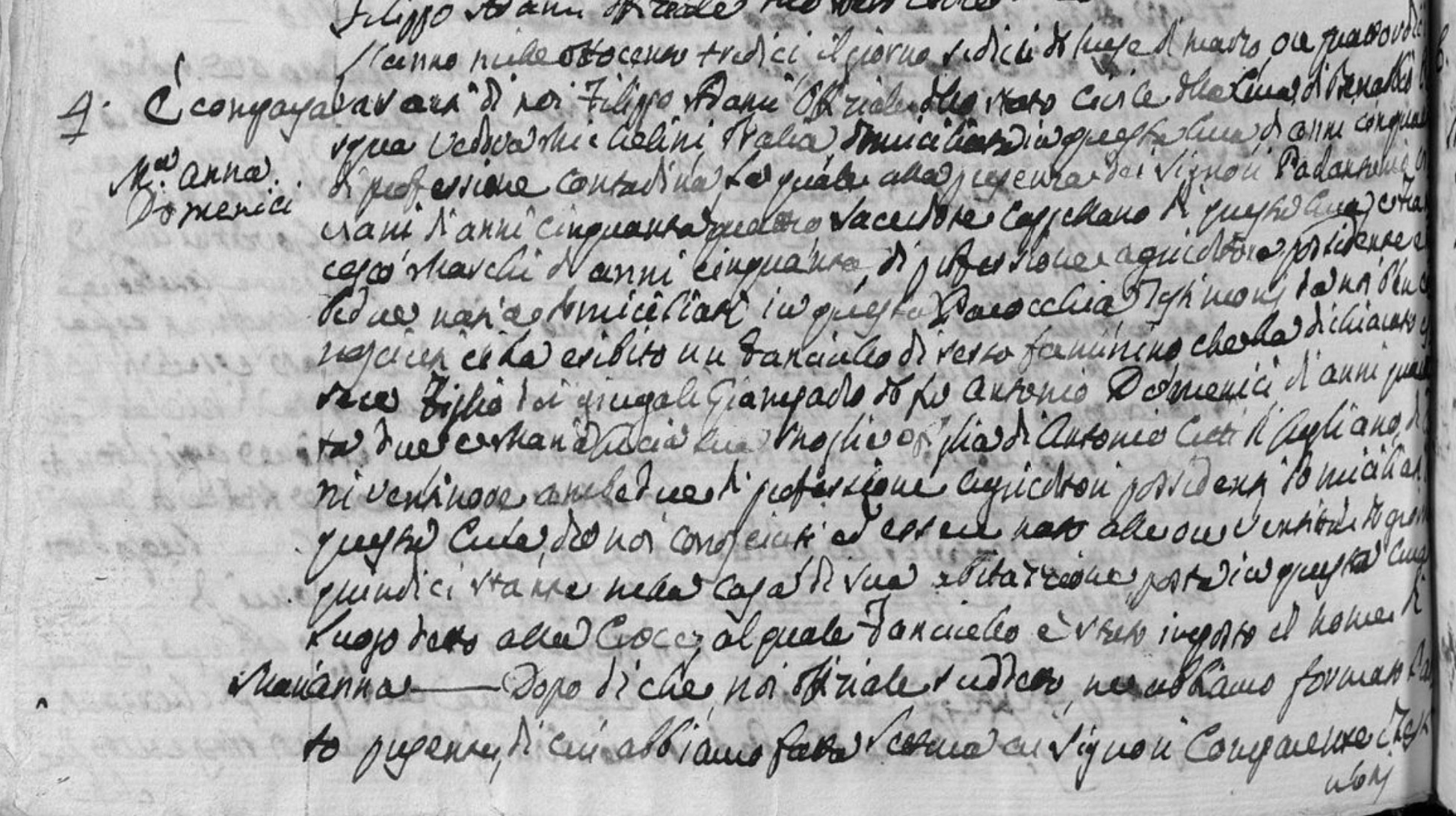
Three Andrea Domenici and One Missing Mother
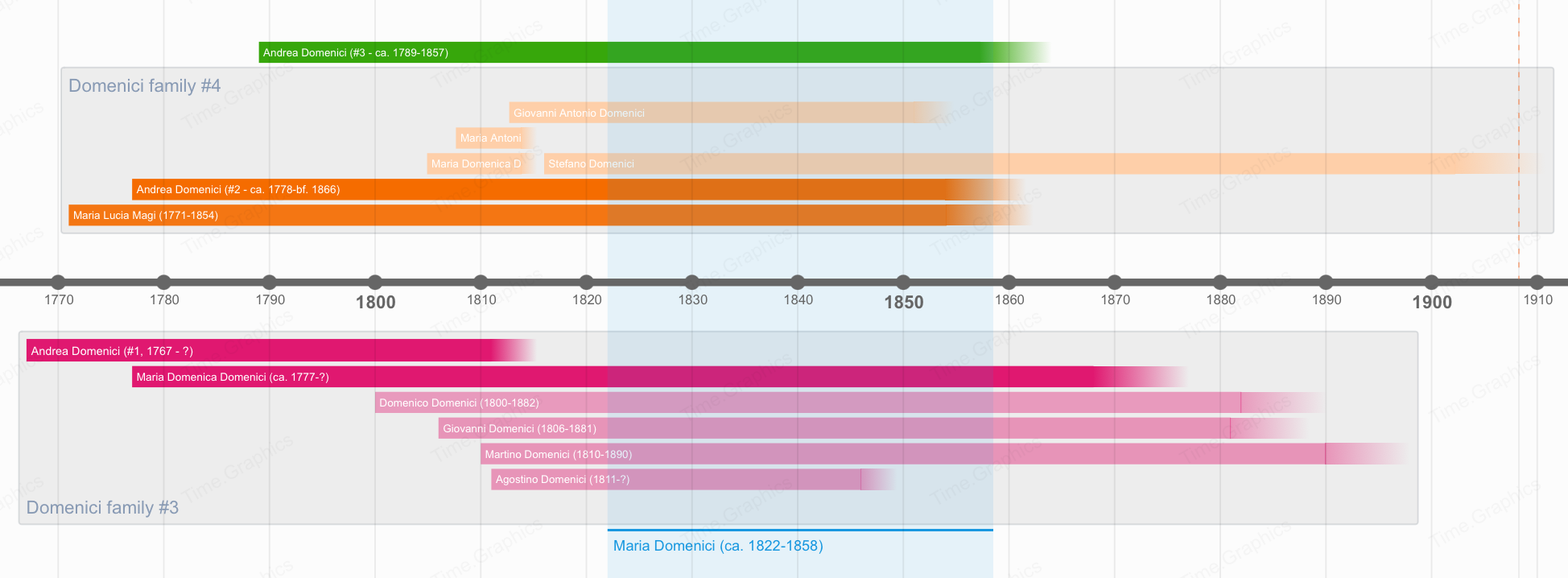
At this stage, one major inconsistency remained. None of the known spouses of these three Andrea Domenici were named Giovanna, as recorded in Maria’s marriage and death entries. On the surface, this appears to be a critical mismatch. However, the structure and limitations of the records leave room for alternative interpretations. It is entirely possible that Maria’s biological mother was from a later marriage, and that only the first wives of these men—those recorded in connection with children born between 1800 and 1816—have been identified. Given the gaps in the records, especially around 1822, this remains a plausible explanation.
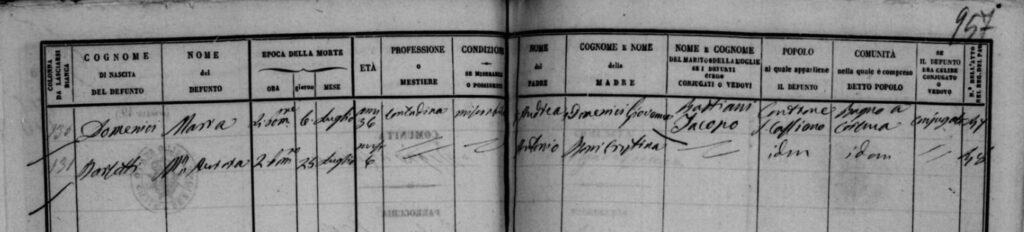
A small detail in the marriage record then introduced a new constraint into the analysis. Both of Maria’s parents are listed with a “g.” preceding their names—an abbreviation of the Italian già, meaning “the late.” This indicates that both Andrea Domenici and Giovanna Domenici were already deceased at the time of Maria’s marriage in October 1857.
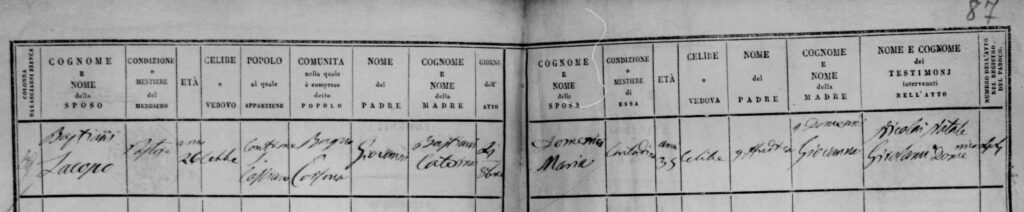
This observation refines the criteria significantly. Any viable candidate must not only fit the timeline of Maria’s birth, but must also have died before her marriage in 1857. For the third Andrea, who is recorded as dying in April 1857, this becomes a matter of timing: as his death occurred before the marriage, he remains a possible candidate. For the first and second candidates, whose death dates are not yet firmly established, the requirement is less immediately decisive, but no less important. It now becomes necessary to determine whether they were still alive in 1857, or whether they too had died earlier.
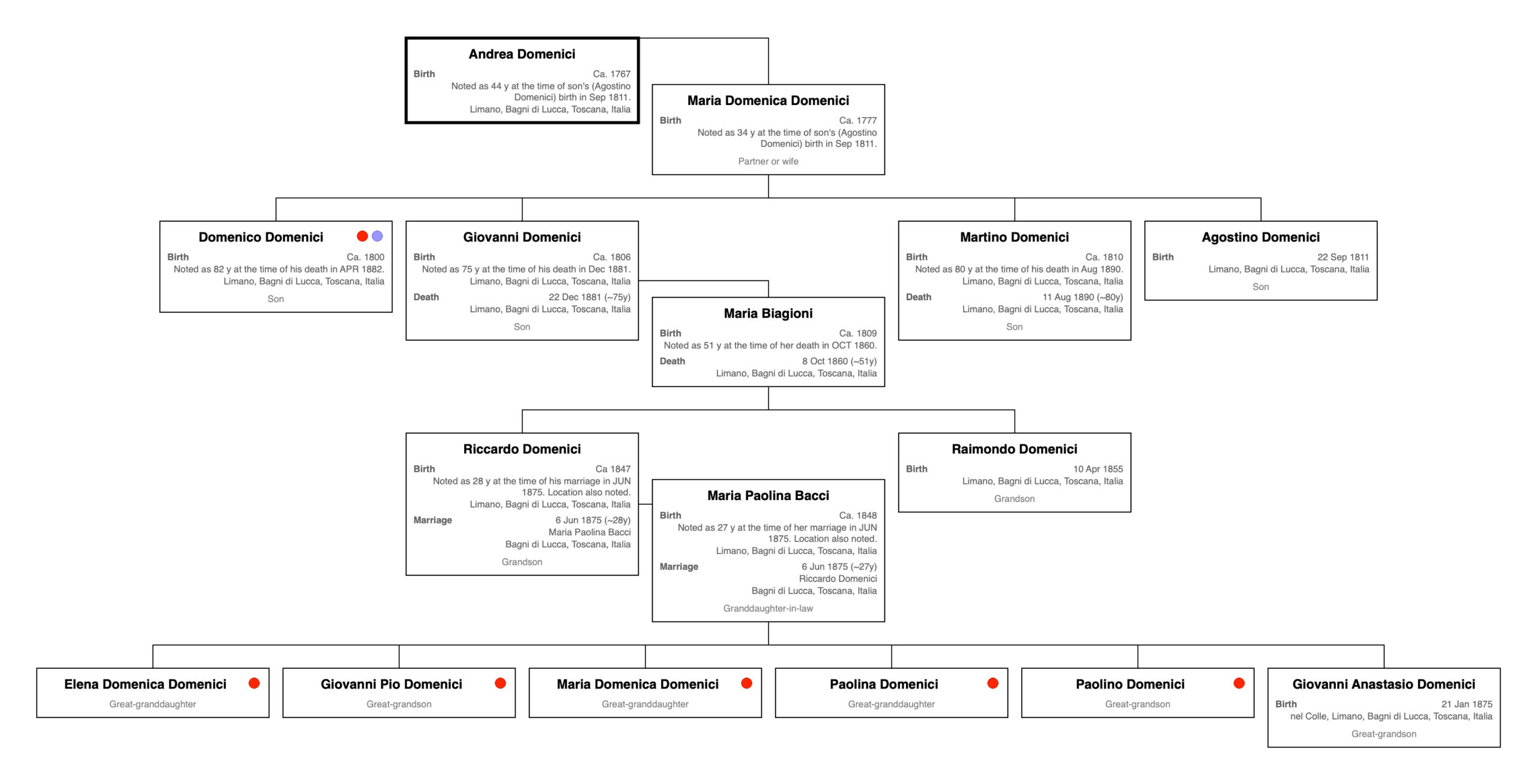
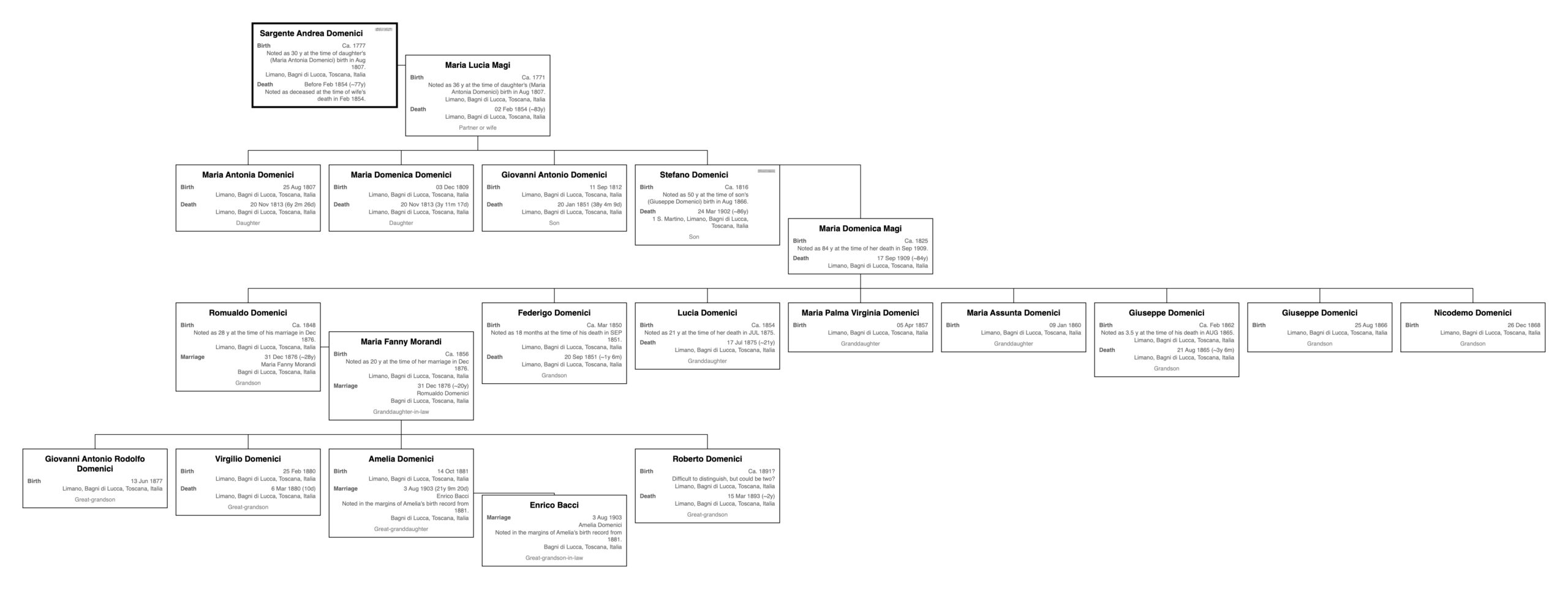
At the same time, the absence of a documented wife named Giovanna remains unresolved. For the third Andrea, this absence is expected, as no spouse is currently known. For the first and second candidates, however, it raises the possibility of additional, undocumented marriages later in life. Without complete death records or subsequent marriage entries, these later unions remain invisible, but entirely plausible.
An additional line of evidence comes from genetic data. While Maria Domenici’s documentary origins remain uncertain, DNA matches from my grandfather’s line suggest a strong connection to Limano. His ancestry is otherwise well established in San Cassiano, Lucchio, and Pistoia, yet he shares notable DNA segments with individuals whose ancestry traces back to Limano families such as Bacci, Licci, Magi, and Bartolini. Many of these individuals have only partial Italian ancestry and no known connection to San Cassiano, which strengthens the significance of the shared matches.
Still looking for answers.
In the absence of other known ancestral links to Limano, it is likely that this connection runs through Maria Domenici herself. Although no direct link has yet been established between these DNA matches and any of the three Andrea Domenici candidates, the genetic evidence supports the hypothesis that Maria originated in Limano rather than elsewhere.
It must be acknowledged that alternative explanations remain possible. Maria Domenici may have come from another village within or beyond Bagni di Lucca that has not yet been fully examined. However, when the available evidence is considered as a whole—the concentration of the surname in Limano, the presence of multiple viable father candidates, the structural gaps in the records, and the supporting DNA evidence—Limano remains the most plausible origin.
What has changed, however, is the nature of the problem. The addition of the già notation transforms the search from a broad survey into a more tightly defined investigation, where chronology and life status at specific moments become critical. The question is no longer simply which Andrea could be Maria’s father, but which one fits all known constraints.
The answer is not yet conclusive, but the field has narrowed. Further progress will depend on identifying indirect evidence—death records, remarriages, or references in the records of siblings and extended family—that can distinguish between the remaining candidates. It is equally possible that the decisive clue will come from a source not yet examined, or from a future connection made through DNA evidence.
For now, Maria Domenici remains just out of reach, but no longer without context. The outlines of her origins are beginning to take shape, and with them, a clearer path forward.
Leave a Reply