Reconstructing the Families and finding Andrea Domenici
The work continues.
Building trees.
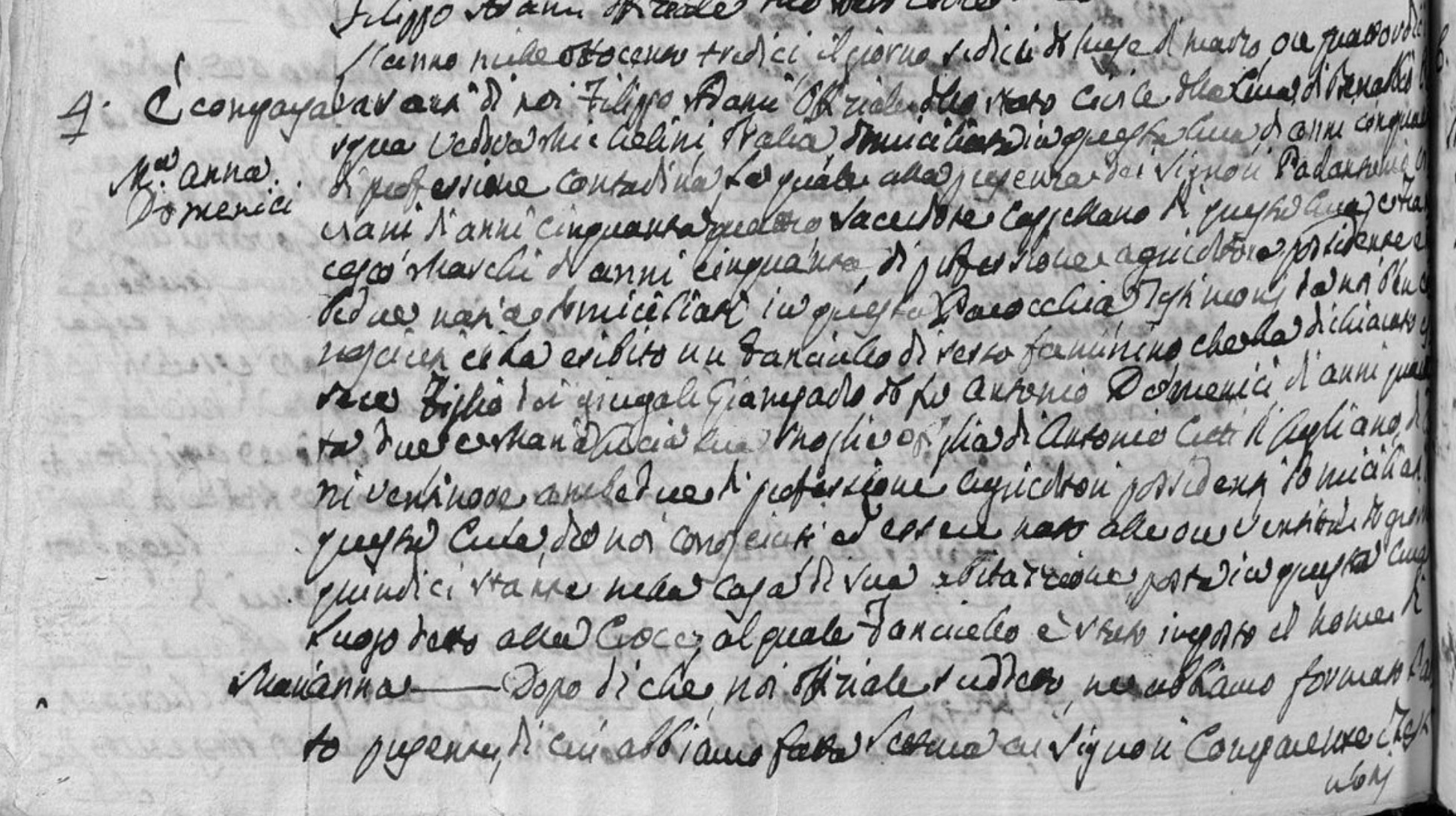
Within Benabbio and Limano, repeated appearances of the same individuals made it possible to begin identifying family units. The same couples would appear at regular intervals, registering the births of children every one to three years, and later reappearing in marriage or death records where additional details—such as parentage and age—were recorded.
These records proved to be exceptionally informative. By combining information across birth, marriage, and death entries, it became possible to reconstruct individual life courses with a high degree of confidence. A person might be identified at birth in 1812, appear again in a marriage record in 1851, and finally in a death record in 1890. As these links accumulated, the entries could be grouped into coherent family structures, often extending across multiple generations.
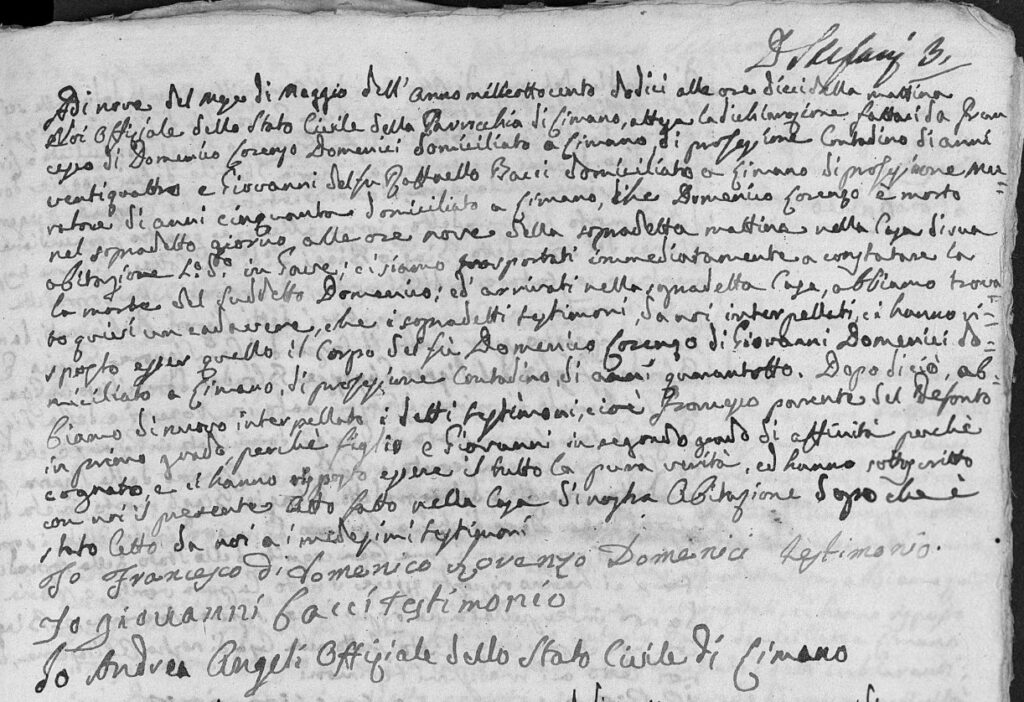
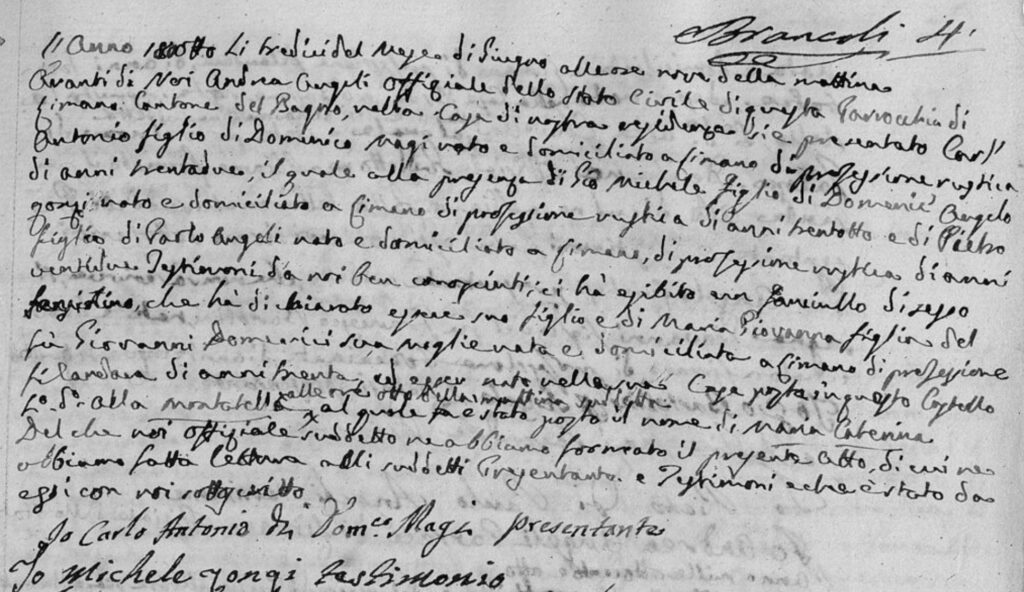
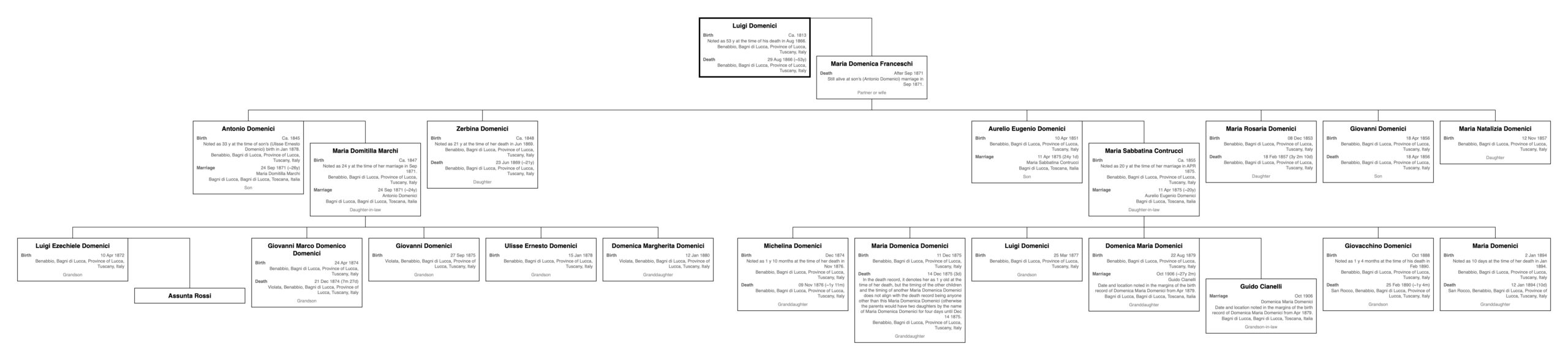
In several cases, it was possible to reconstruct four or even five generations within a single family line (see below). A death record from 1812 might name a man’s parents and spouse, while his children were simultaneously appearing as parents in birth records of their own children. Those grandchildren, in turn, would go on to marry in the 1830s and have children into the 1850s. What initially appeared as disconnected records gradually resolved into continuous, multi-generational narratives.
As these family groups were formalised and entered into the database with full source citations, further patterns became visible. Revisiting the records in this structured context often revealed details that had not been apparent during the initial data collection. At the same time, connections between different family groups began to emerge, showing how families were intertwined through marriage, shared naming patterns, and recurring social roles. In some cases, military titles appeared consistently across multiple generations, suggesting the persistence of status or occupation within certain lineages.
Perhaps the most striking finding was the clear division of the Domenici surname into two distinct clusters: one in Benabbio and one in Limano. Despite the breadth of available records from 1807 onward, there is no evidence of individuals moving between these two villages. Not a single case has been identified in which a Domenici from one village appears in the records of the other. This raises the possibility that the two groups had already diverged before the beginning of the surviving record sets, or that they had always existed as separate family branches. Given the geographical distance between the villages (almost 17 km), the latter explanation appears entirely plausible. Within each village, however, the opposite pattern is observed: families remain local, closely connected, and deeply embedded within their communities.
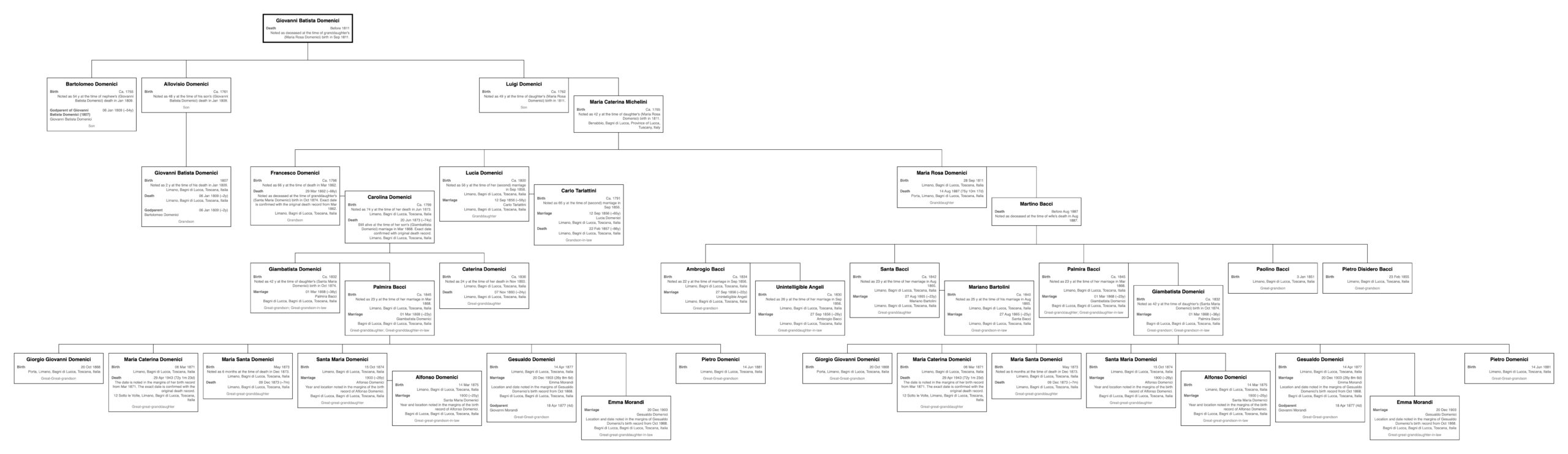
Click on the figures to enlarge and zoom to see some of the elaborate descendant charts created in the process.
Back to the original question
It was within this reconstructed framework that a new and more specific question emerged. Among all the individuals identified, how many could realistically be Maria Domenici’s father?
Among the more than 330 entries collected for the Domenici surname, four individuals named Andrea Domenici were identified. One of these could be excluded immediately: a young boy born in 1873 who died at the age of two, far too late to be considered a candidate. This left three possible fathers, all living in Limano, and all belonging to the same broader network of families. These were the only three men by the name of Andrea Domenici located in the entire comune of Bagni di Lucca in the available years.

The first Andrea Domenici appears to have been born around 1767, the son of Pier Antonio Domenici. He was married to Maria Domenica Domenici (ca. 1777–?), and together they had several known children between 1800 and 1811, including Domenico, Giovanni, Martino, and Agostino.
The second candidate, Andrea Domenici—identified in the records with the title of sergeant and captain—was born around 1778, the son of Domenico Domenici. He was married to Maria Lucia Magi (ca. 1771–?), and their children were born between 1807 and 1816. Among them are two daughters named Maria Domenica and Maria Antonia, both of whom died young, as well as sons Giovanni Antonio and Stefano. This is the candidate whose known children were born closest in time to Maria’s birth in 1822, with son Stefano Domenici born in ca. 1816.


The third Andrea Domenici, born around 1789, is in many ways the most elusive. He is the son of Luigi Domenici and Maria Domenica Angeli, and is recorded as having died in April 1858 in Limano. Beyond this, however, no confirmed spouse or children have yet been identified in the available records.
At this point, the problem had shifted. The question was no longer where Maria Domenici came from, but which of these three men—living at the same time, in the same village—could have been her father. At first glance, the answer seemed straightforward. In reality, it was anything but.
Leave a Reply